If you are planning to attend Harvard Law School, one of the first questions you may ask is, “What LSAT score do I need for Harvard?” Harvard Law School is one of the most selective law schools in the United States, and your LSAT score can play an important role in your application. However, getting into Harvard Law School is not based on your LSAT score alone.
A very high LSAT score can strengthen your application, but Harvard also considers your undergraduate GPA, academic record, personal statement, letters of recommendation, work experience, extracurricular activities, leadership, and other aspects of your application.
For applicants targeting Harvard Law School, an LSAT score in the 170s is generally considered competitive. A score around 174 or higher can put you in a stronger position, while a score below that does not automatically mean you cannot be admitted.
The key is to understand that there is no single LSAT score that guarantees admission to Harvard. Instead, applicants should aim for the highest score possible while building a strong overall application.
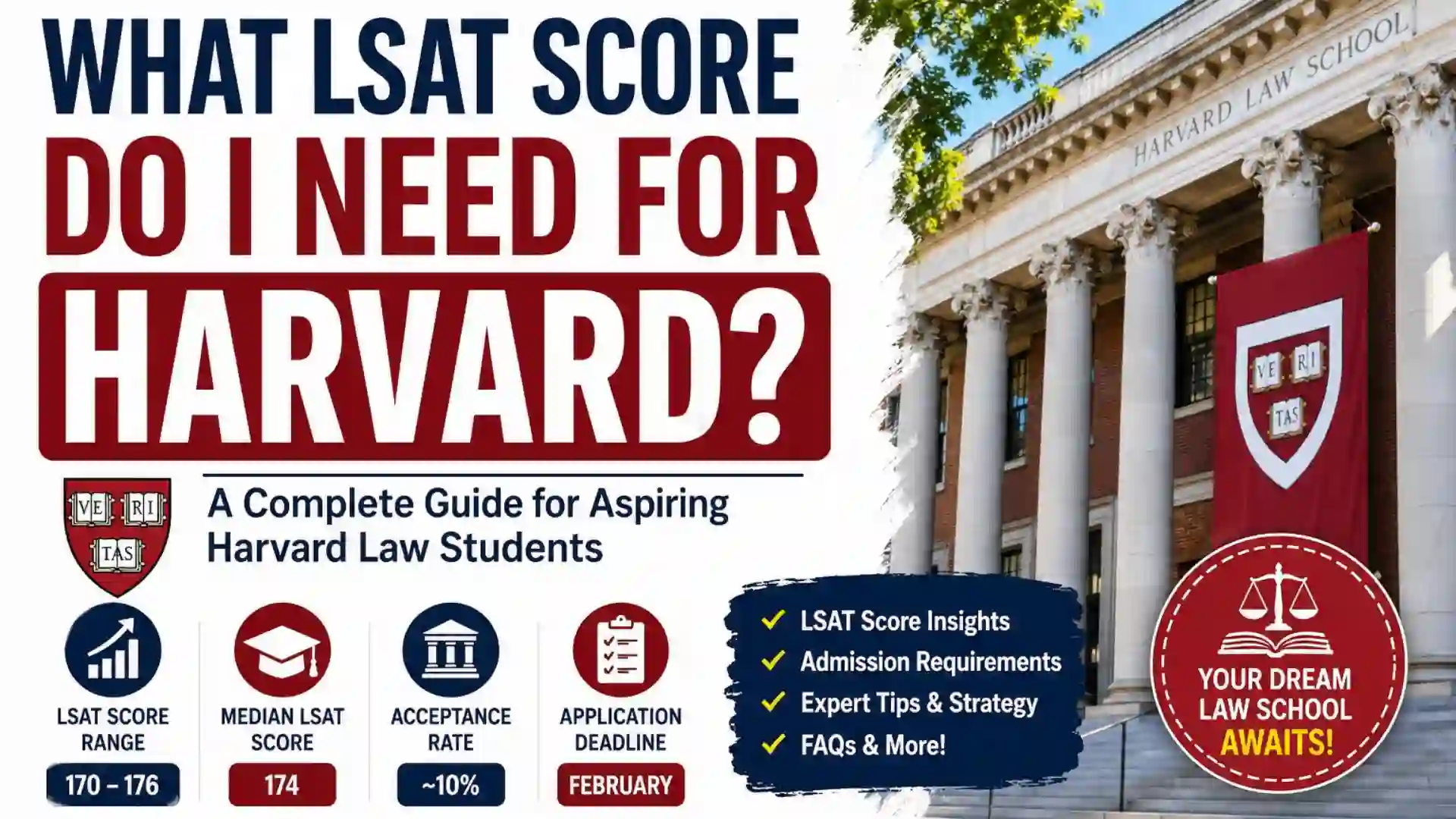
Quick Answer: What LSAT Score Do I Need for Harvard?
If Harvard Law School is your target, you should ideally aim for an LSAT score in the 170–180 range, with a score around 174 or higher being a particularly strong target.
Harvard Law School has historically had an LSAT median in the mid-170s. Because the LSAT is scored from 120 to 180, a score in the 170s represents excellent performance.
However, a 174 LSAT score does not guarantee admission, and a lower score does not automatically eliminate you from consideration.
For example, an applicant with a 171 LSAT score and an exceptional academic and personal profile may have a stronger application than someone with a 176 LSAT score but a weaker overall application.
Your goal should therefore be to maximize both your LSAT score and the strength of the rest of your application.
Important Harvard Law School LSAT Information
| Information | Details |
|---|---|
| Law School | Harvard Law School |
| Location | Cambridge, Massachusetts |
| Degree | Juris Doctor (J.D.) |
| LSAT Score Range | 120–180 |
| Recommended Target | 174+ |
| Highly Competitive Range | 175–180 |
| Undergraduate GPA | A very strong GPA is recommended |
| LSAT Requirement | Check current Harvard admissions requirements |
| Application Platform | LSAC |
| Personal Statement | Required as part of the application |
| Letters of Recommendation | Important part of the application |
| Work Experience | Can strengthen an application |
| Extracurricular Activities | Can contribute to a strong application |
| Admission Difficulty | Extremely competitive |
What Is a Good LSAT Score for Harvard?
A good LSAT score for Harvard is generally one that places you near the top of the applicant pool.
Since Harvard Law School is among the most selective law schools in the country, simply achieving a score that is considered good at many other law schools may not be enough to make your application highly competitive.
A score of 170 or above is excellent in general law-school admissions terms. However, Harvard applicants often need to think beyond simply reaching 170.
Here is a general way to think about LSAT scores:
| LSAT Score | General Assessment for Harvard |
| 180 | Exceptional |
| 177–179 | Extremely strong |
| 174–176 | Very competitive |
| 171–173 | Competitive but highly dependent on application |
| 168–170 | Strong LSAT score, but Harvard becomes more difficult |
| 165–167 | Excellent generally, but a reach for Harvard |
| Below 165 | Harvard admission becomes significantly more difficult |
These ranges should not be interpreted as official Harvard admission cutoffs. Harvard does not simply admit everyone above a particular LSAT score or reject everyone below it.
Your entire application matters.
Is a 170 LSAT Score Good Enough for Harvard?
A 170 is an excellent LSAT score. However, if Harvard Law School is your primary target, you should understand that a 170 may not provide the same level of competitiveness as a score in the mid-170s.
A 170 means that you performed exceptionally well compared with most LSAT test takers. Nevertheless, Harvard’s applicant pool contains many students with exceptionally high LSAT scores.
If you have a 170 LSAT score, you should not automatically remove Harvard from your list.
Instead, consider the rest of your profile.
A strong undergraduate GPA, outstanding academic achievements, meaningful work experience, excellent recommendations, a compelling personal statement, and a distinctive background can all contribute to your application.
You should also apply to a range of law schools rather than relying entirely on Harvard.
Is a 175 LSAT Score Good for Harvard?
Yes. A 175 LSAT score is an excellent score for a Harvard Law School applicant.
A score of 175 places you in a very strong position academically. However, it still does not guarantee admission.
At highly selective law schools, the applicant pool contains many students with excellent credentials. Admissions officers therefore need to evaluate applicants beyond standardized test scores.
If you have a 175 LSAT score and a strong undergraduate GPA, you have a compelling academic foundation for your application.
At that point, your personal statement, recommendations, resume, academic history, and overall story become especially important.
Can I Get Into Harvard Law School With a 165 LSAT?
It is possible, but it would generally be considered a significant reach.
A 165 is a strong LSAT score overall. Many excellent law schools accept students with scores around this level. Harvard, however, is significantly more competitive.
If your LSAT score is 165 and you are considering Harvard, you should evaluate whether retaking the LSAT could realistically improve your score.
For example, if practice tests consistently show that you can score in the 170s, additional preparation may be worthwhile.
However, you should not assume that taking the LSAT repeatedly will automatically improve your application. The best approach is to prepare strategically and retake only when you have a reasonable expectation of improving your score.
Does Harvard Require a Specific LSAT Score?
Harvard Law School does not have a simple publicly stated LSAT cutoff that guarantees or prevents admission.
This distinction is important.
Some students search for a number such as “Harvard requires a 175 LSAT.” That is not how law-school admissions work.
Instead, Harvard evaluates applications holistically.
A particular LSAT score can make an applicant more or less competitive, but the score is only one component of the application.
Therefore, you should think of the LSAT as an important part of your application rather than a pass-or-fail requirement.
Harvard LSAT Score and GPA
Your LSAT score is particularly important when considered together with your undergraduate GPA.
For example, an applicant with a 175 LSAT and a 3.9+ GPA presents a very strong academic profile.
Another applicant might have a 178 LSAT but a significantly lower GPA. That applicant may still have a strong application, but the admissions committee will consider the entire academic record.
There is no single combination of LSAT and GPA that guarantees admission.
A simplified way to think about your academic profile is:
LSAT + GPA + Academic Record + Overall Application = Admissions Profile
Your undergraduate institution, course selection, academic trends, and other educational experiences can also provide context for your GPA.
What GPA Do I Need for Harvard Law School?
Harvard Law School applicants generally benefit from having an excellent undergraduate GPA.
A GPA around the upper 3.8s or 3.9 range can provide a strong academic foundation, especially when paired with a high LSAT score.
However, there is no GPA that guarantees admission.
If your GPA is lower than the typical Harvard applicant, you should not assume that admission is impossible. Other factors may strengthen your application.
For example, a student may have experienced difficult circumstances, demonstrated significant academic improvement, performed exceptionally well in advanced coursework, or developed an impressive professional record.
The important thing is to present your academic history accurately and provide appropriate context when necessary.
Does a High LSAT Score Guarantee Harvard Admission?
No.
This is one of the most important things to understand about Harvard Law School admissions.
Even an LSAT score of 180 does not guarantee admission.
The LSAT measures specific skills relevant to legal education, but it does not tell the admissions committee everything about an applicant.
Harvard can receive applications from many students with exceptional LSAT scores.
As a result, the admissions committee also considers factors such as:
- Undergraduate academic performance
- Personal statement
- Letters of recommendation
- Resume
- Professional experience
- Leadership
- Extracurricular activities
- Community involvement
- Academic achievements
- Personal background and experiences
- Overall fit and potential contribution to the law-school community
A high LSAT score can help you get noticed, but your application needs to tell a compelling story.
How Much Does the LSAT Matter for Harvard?
The LSAT matters significantly because it is a standardized measure that allows law schools to evaluate applicants from different academic backgrounds.
However, the LSAT should not be treated as the only factor that matters.
For a Harvard applicant, achieving a score in the 170s can help establish that you are academically prepared for a highly demanding law-school environment.
If your LSAT score is lower than you hoped, you should look at the entire application before deciding whether you are competitive.
For example, a strong personal statement and excellent recommendations cannot necessarily compensate for a major difference in LSAT performance, but they can help demonstrate qualities that an LSAT score cannot measure.
Should You Retake the LSAT for Harvard?
Whether you should retake the LSAT depends on your current score, practice-test performance, preparation level, and application timeline.
Suppose you receive a 168 on your first attempt but consistently score between 172 and 175 on practice tests. A retake could potentially make sense.
On the other hand, if you score 174 and your practice tests are consistently around the same range, you should consider whether the time spent preparing for another attempt would be better used improving the rest of your application.
Before retaking the LSAT, consider:
- Your current LSAT score
- Your average practice-test score
- Your target score
- How much additional preparation time you have
- Your application deadline
- Your GPA
- The strength of your overall application
The goal is not simply to take the LSAT as many times as possible. The goal is to submit the strongest application you can.
How to Prepare for a Harvard-Level LSAT Score?
If you want to target a score in the 170s, preparation should be systematic.
Start by taking a full-length diagnostic test under realistic conditions.
Your diagnostic score provides a baseline.
Next, identify your weaknesses.
For some students, Logical Reasoning is the biggest challenge. For others, Reading Comprehension may require more attention. The current LSAT format should always be considered when choosing preparation materials, because the exam has changed over time.
After identifying your weaknesses, create a structured study schedule.
A typical preparation strategy can include:
Learn the Fundamentals
Before taking dozens of practice tests, make sure you understand the underlying concepts and question types.
You should know why an answer is correct rather than simply memorizing patterns.
Complete Timed Practice
Once you understand the fundamentals, begin practicing under timed conditions.
Timing is particularly important because the LSAT requires you to make accurate decisions under significant time pressure.
Review Every Mistake
One of the most effective ways to improve is to carefully review incorrect answers.
Do not simply record that you missed a question.
Ask why you missed it.
Was it a misunderstanding of the question?
Did you misread an answer choice?
Did you run out of time?
Did you make an assumption that the passage did not support?
Understanding your mistakes can help prevent them from happening again.
Take Full-Length Practice Tests
As your test date approaches, complete full-length practice exams.
Use realistic testing conditions whenever possible.
After each test, spend significant time reviewing your performance.
Your practice-test average is more useful than one unusually high score.
What If My LSAT Score Is Below 170?
Do not panic.
A score below 170 does not mean that you cannot become a successful lawyer or attend a highly respected law school.
If Harvard is your dream school, however, you should understand that the admission process becomes more challenging as your LSAT score moves farther below the school’s typical range.
You have several options.
You can consider retaking the LSAT, strengthen the rest of your application, apply to a broader group of law schools, or do all three.
The best law school for you is not necessarily the one with the most famous name.
Consider employment outcomes, scholarships, location, practice areas, alumni networks, bar-passage outcomes, cost, and your long-term career goals.
How Many Times Can You Take the LSAT?
LSAT administration policies can change, so applicants should always check the current rules before registering.
If you are planning multiple attempts, make sure you understand the current limits and how law schools will view multiple scores.
More importantly, do not approach every test attempt casually.
A retake should have a clear purpose.
If you want to increase your score from 170 to 175, for example, you should identify what prevented you from reaching your target score during your previous attempt and create a specific plan to address those weaknesses.
Other Parts of Your Harvard Law Application
Your LSAT score is only one component of your application.
Personal Statement
Your personal statement gives the admissions committee an opportunity to understand your motivations, experiences, and perspective.
Avoid simply repeating your resume.
Instead, use the statement to communicate something meaningful about who you are and why your experiences have influenced your goals.
Letters of Recommendation
Strong recommendation letters can provide evidence of your academic ability, intellectual curiosity, work ethic, leadership, and character.
Whenever possible, choose recommenders who know your work well rather than simply choosing someone with an impressive title.
Resume
Your resume should clearly communicate your academic, professional, extracurricular, and leadership experiences.
Focus on achievements and responsibilities rather than simply listing positions.
Academic Record
Your transcript provides more information than your cumulative GPA.
Admissions committees can consider your course selection, academic progression, and performance across different subjects.
Should You Apply to Harvard With a 170 LSAT?
If Harvard is one of your top choices, you can certainly apply with a 170.
The important point is to understand that Harvard should probably be treated as a highly competitive application rather than a guaranteed outcome.
You should also build a balanced law-school application list.
A sensible application strategy may include:
- Reach schools
- Target schools
- Safer schools
This approach gives you more options.
Even applicants with outstanding LSAT scores should avoid assuming that they will automatically be admitted to a particular law school.
How to Improve Your Chances of Getting Into Harvard Law School?
If Harvard is your goal, focus on the entire application rather than obsessing over one number.
First, aim for the highest LSAT score you can realistically achieve.
Second, maintain an excellent undergraduate academic record.
Third, develop meaningful experiences outside the classroom.
Fourth, build relationships with professors and supervisors who can eventually write strong recommendation letters.
Fifth, create a personal statement that provides insight into your experiences and motivations.
Finally, submit a carefully prepared application.
Small mistakes, weak writing, rushed essays, or an unclear application strategy can undermine an otherwise strong academic profile.
Important Links and Resources
| Resource | What It Is Used For |
| Harvard Law School | Learn about Harvard Law School and its programs |
| Harvard Law Admissions | Review admissions information and application requirements |
| LSAC | Register for the LSAT and manage your law-school application |
| LSAT | Learn about the standardized law-school admission test |
| Harvard J.D. Program | Learn about Harvard’s Juris Doctor program |
| Law School Application | Understand the general application process |
Applicants should always verify current requirements, deadlines, testing policies, and application procedures directly through the relevant official organizations before submitting an application.
FAQ
Final Thoughts: What LSAT Score Do I Need for Harvard?
So, what LSAT score do you need for Harvard?
There is no single magic number.
If Harvard Law School is your goal, targeting an LSAT score in the 170s is a sensible strategy, and a score around 174 or higher can put you in a stronger position academically. A score of 175 or above is particularly competitive.
However, your LSAT score is only one part of your application.
A strong Harvard applicant should combine an excellent LSAT score with a strong undergraduate GPA, meaningful academic and professional experiences, compelling written materials, strong recommendations, and a clear personal narrative.
If your LSAT score is below 170, do not automatically assume that Harvard is impossible. Consider whether retaking the test could improve your score and whether the rest of your application can demonstrate your strengths.
At the same time, build a balanced law-school application list. Harvard is highly selective even for applicants with exceptional credentials, so having alternatives is important.
Ultimately, the best approach is to prepare thoroughly, aim for the highest LSAT score you can achieve, maintain a strong academic record, and present an application that clearly communicates why you would be an excellent addition to the Harvard Law School community.