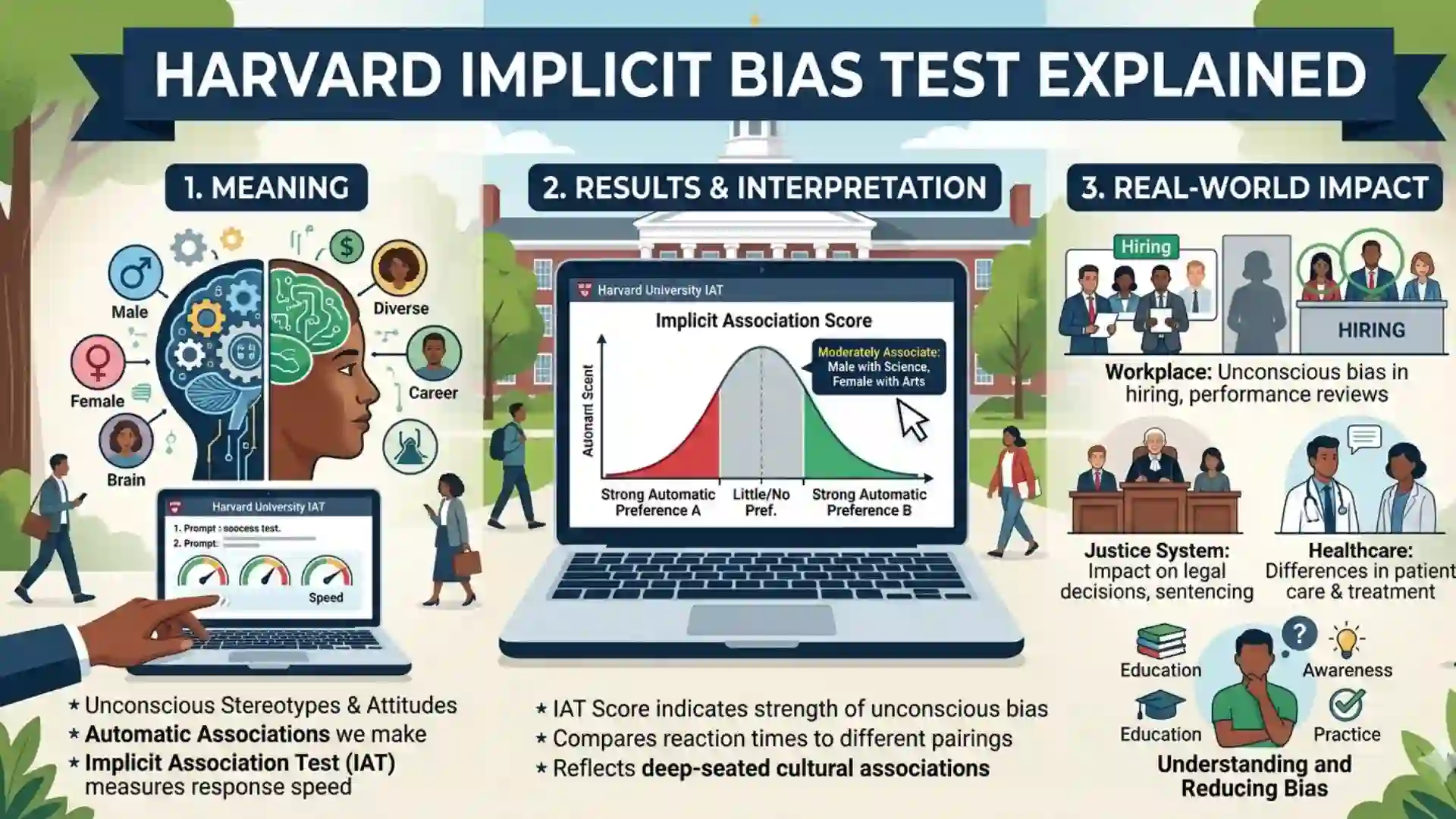
Harvard Implicit Bias Test: The concept of unconscious or implicit bias has gained significant attention in recent years, especially in fields like education, employment, healthcare, and public policy. One of the most widely discussed tools for measuring such biases is the Harvard Implicit Bias Test, formally known as the Implicit Association Test (IAT). Developed through collaborative research at Harvard University, the University of Washington, and the University of Virginia, this test has become a central instrument in understanding hidden attitudes that individuals may not consciously recognize.
This article provides a comprehensive overview of the Harvard Implicit Bias Test, including its meaning, structure, significance, criticisms, and practical applications. It also includes important resources, frequently asked questions, and a detailed conclusion to help readers understand the topic thoroughly.
What Is the Harvard Implicit Bias Test?
The Harvard Implicit Bias Test, commonly referred to as the Implicit Association Test (IAT), is a psychological assessment designed to measure the strength of associations between concepts in the human mind. It examines how quickly individuals categorize words and images, revealing unconscious biases that may exist beneath conscious awareness.
The test is hosted online through Project Implicit, a non-profit research collaboration focused on studying implicit social cognition.
Unlike traditional surveys where individuals consciously report their beliefs, the IAT works by measuring reaction times. Faster responses indicate stronger mental associations, which may reveal preferences or biases related to race, gender, age, religion, disability, and more.
The Origin and Development of the IAT
The Implicit Association Test was introduced in 1998 by researchers including Anthony G. Greenwald, Mahzarin R. Banaji, and Brian A. Nosek. Their work aimed to explore how unconscious biases influence behavior and decision-making.
The researchers recognized that many individuals hold implicit attitudes that differ from their explicit beliefs. For example, someone who consciously supports equality may still unconsciously associate certain groups with negative traits due to societal conditioning.
The development of the IAT marked a significant breakthrough in the field of Social Psychology, offering a measurable way to study hidden cognitive processes.
How the Harvard Implicit Bias Test Works?
The test involves a series of rapid categorization tasks where participants are asked to sort words or images into predefined categories. These tasks are timed, and the speed of responses is analyzed.
Basic Structure of the Test
- Categorization Tasks
Participants are presented with words or images on a screen and must quickly assign them to categories using specific keys. - Paired Associations
The test pairs categories such as “Good” and “Bad” with concepts like “Male” or “Female,” or “Young” and “Old.” - Reaction Time Measurement
The system records how quickly participants respond. Faster responses suggest stronger mental associations. - Comparison of Results
The test compares reaction times across different pairings to determine implicit preferences or biases.
Example
In a race-based IAT, participants might be asked to associate positive or negative words with faces of different racial groups. If a participant responds faster when certain groups are paired with positive words, it may indicate an implicit preference.
Types of Implicit Bias Tests Available
The Harvard IAT offers a wide range of tests covering different dimensions of bias. Some of the most common include:
- Race Bias Test
- Gender-Career Bias Test
- Age Bias Test
- Religion Bias Test
- Disability Bias Test
- Sexual Orientation Bias Test
- Skin Tone Bias Test
Each test is designed to explore specific unconscious associations that individuals may hold.
Importance of the Harvard Implicit Bias Test
1. Awareness of Hidden Biases
One of the primary benefits of the IAT is that it helps individuals become aware of biases they may not consciously recognize. This awareness is the first step toward behavioral change.
2. Improving Decision-Making
Implicit biases can influence decisions in hiring, promotions, education, and healthcare. By identifying these biases, individuals and organizations can work toward more objective decision-making.
3. Promoting Diversity and Inclusion
Organizations use the IAT as part of diversity and inclusion training programs to encourage fair treatment and reduce discrimination.
4. Academic and Research Applications
The test is widely used in academic research to study human behavior, social attitudes, and cultural influences.
Applications in Real Life
1. Workplace
Employers use implicit bias testing to identify unconscious preferences that may affect hiring and promotion decisions. Many companies integrate bias awareness training into their HR policies.
2. Education
Teachers and educational institutions use insights from the IAT to create inclusive learning environments and address disparities in student outcomes.
3. Healthcare
Healthcare professionals use implicit bias awareness to improve patient care and reduce disparities in treatment.
4. Law and Criminal Justice
The test has been used in discussions about fairness in policing, jury decisions, and sentencing.
Criticisms and Limitations of the IAT
Despite its popularity, the Harvard Implicit Bias Test has faced criticism from researchers and scholars.
1. Reliability Concerns
Some critics argue that the test results may vary over time and are not always consistent.
2. Predictive Validity
There is debate about whether implicit biases measured by the IAT actually predict real-world behavior.
3. Overinterpretation
Experts caution against treating the results as definitive proof of prejudice. The test indicates tendencies, not fixed beliefs.
4. Cultural and Contextual Factors
Results may be influenced by cultural exposure, media, and societal norms rather than personal beliefs.
Important Links and Information
Below is a table containing essential resources and information related to the Harvard Implicit Bias Test:
| Resource / Information | Details |
|---|---|
| Official Test Platform | https://implicit.harvard.edu |
| Research Initiative | Project Implicit |
| Developed By | Harvard University and partner institutions |
| Test Name | Implicit Association Test (IAT) |
| Year Introduced | 1998 |
| Key Researchers | Anthony G. Greenwald, Mahzarin R. Banaji, Brian A. Nosek |
| Field of Study | Social Psychology |
| Cost | Free |
| Accessibility | Available online worldwide |
| Test Duration | 5–10 minutes per test |
How to Take the Harvard Implicit Bias Test?
Taking the test is simple and requires only a computer or smartphone with internet access.
Steps:
- Visit the official Project Implicit website.
- Select your country and preferred language.
- Choose the type of bias test you want to take.
- Read the instructions carefully.
- Complete the test by responding as quickly as possible.
- Review your results and interpretation.
Understanding Your Results
After completing the test, participants receive a summary of their implicit preferences. The results are typically categorized as:
- Strong preference
- Moderate preference
- Slight preference
- Neutral
It is important to interpret these results cautiously. They reflect unconscious tendencies, not deliberate beliefs or actions.
Strategies to Reduce Implicit Bias
Recognizing implicit bias is only the first step. The next step is taking action to reduce its impact.
1. Increase Awareness
Regularly reflecting on one’s thoughts and behaviors can help identify patterns of bias.
2. Exposure to Diversity
Interacting with people from different backgrounds can reduce stereotypes and broaden perspectives.
3. Mindful Decision-Making
Taking time to evaluate decisions objectively can help minimize the influence of bias.
4. Training and Education
Participating in workshops and diversity training programs can provide tools for managing bias.
5. Institutional Policies
Organizations can implement policies that promote fairness and accountability.
Ethical Considerations
The use of implicit bias testing raises several ethical questions:
- Should test results be used in hiring decisions?
- How should organizations handle employee data?
- Can individuals be judged based on unconscious biases?
Most experts agree that the test should be used as a tool for awareness and education, not as a basis for punishment or discrimination.
Role of Technology in Bias Measurement
Advancements in technology have made it easier to measure and analyze implicit biases. Online platforms, data analytics, and artificial intelligence are being used to study patterns in human behavior.
However, technology also introduces challenges, such as data privacy concerns and the risk of misuse.
Future of Implicit Bias Research
Research on implicit bias continues to evolve. Scholars are exploring new methods to improve the accuracy and reliability of tests like the IAT.
Future developments may include:
- More advanced testing techniques
- Integration with neuroscience research
- Improved predictive models
- Greater focus on real-world applications
FAQ about Harvard Implicit Bias Test 2026
What is the Harvard Implicit Bias Test?
It is an online psychological test that measures unconscious biases using reaction times.
Is the test accurate?
The test provides useful insights but is not perfectly reliable. Results should be interpreted cautiously.
Is the test free?
Yes, it is available for free through Project Implicit.
How long does the test take?
Most tests take between 5 to 10 minutes.
Can the results change over time?
Yes, results can vary depending on experiences, environment, and context.
Does the test label someone as biased?
No, it only identifies implicit tendencies, not conscious beliefs or character.
Who should take the test?
Anyone interested in understanding their unconscious biases can take it.
Is the test used in hiring?
Some organizations use it for training purposes, but it is generally not used as a hiring criterion.
Conclusion
The Harvard Implicit Bias Test, or Implicit Association Test, represents a significant advancement in understanding human cognition and behavior. Developed through collaboration among leading institutions like Harvard University and supported by Project Implicit, the test offers valuable insights into unconscious biases that shape our perceptions and actions.
While the test has limitations and should not be used as a definitive measure of character, it serves as a powerful tool for self-awareness and education. By helping individuals recognize hidden biases, the IAT encourages more thoughtful decision-making and promotes fairness in various aspects of life.
In a world that is increasingly diverse and interconnected, understanding implicit bias is essential. The Harvard Implicit Bias Test provides a starting point for this journey, enabling individuals and organizations to work toward greater equity, inclusion, and mutual respect.
Ultimately, the value of the test lies not in the results themselves but in how individuals use those insights to foster positive change.