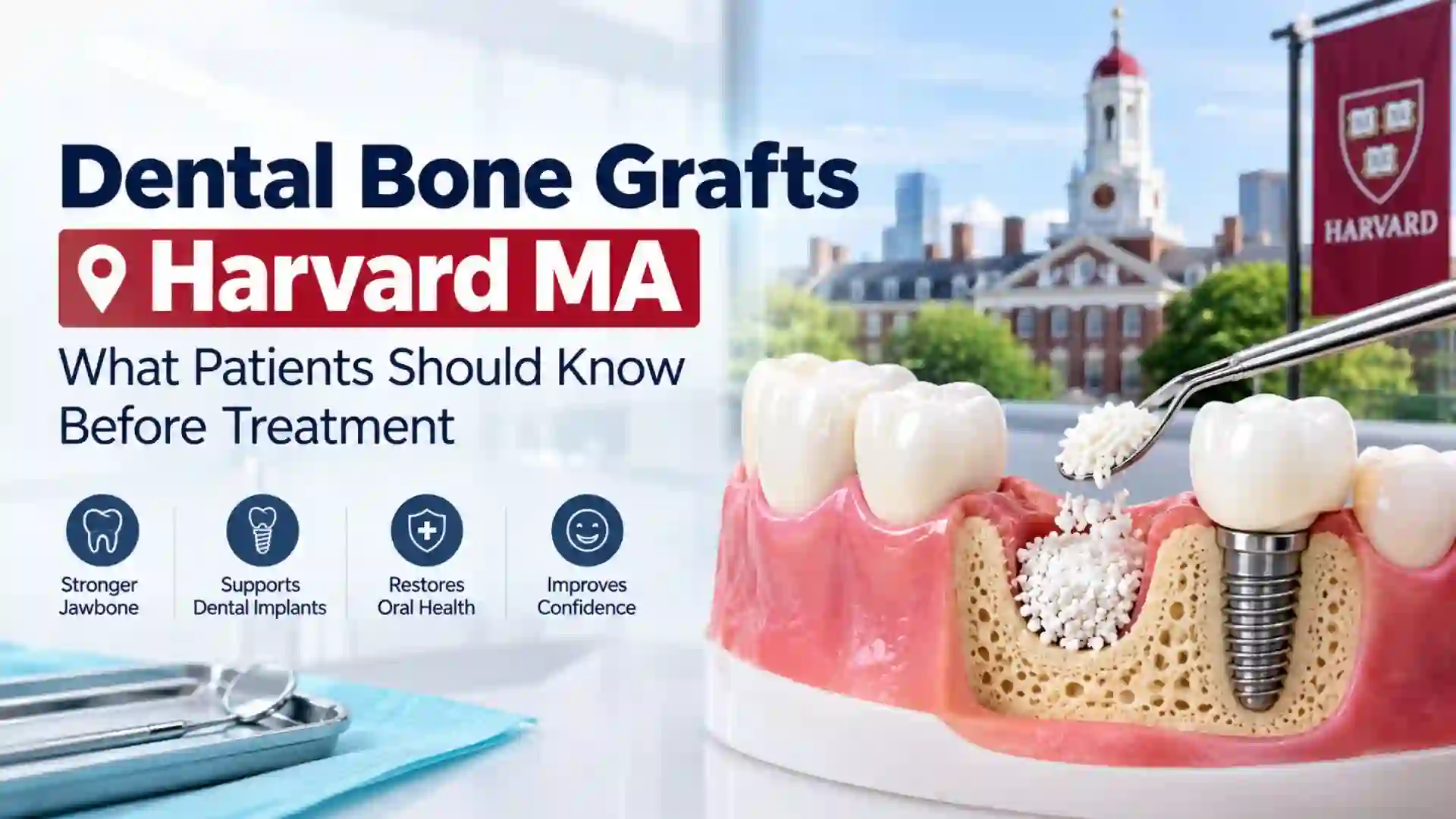
Dental Bone Grafts Harvard MA: If you have been told that you may need a dental implant but do not have enough jawbone to support it, you may be researching dental bone grafts in Harvard MA. Bone grafting is a common dental procedure used to rebuild areas of the jaw where bone has been lost or become too thin for certain dental treatments.
Jawbone loss can happen for several reasons, including missing teeth, tooth extraction, gum disease, injury, infection, or long-term use of dentures. When a tooth is missing, the surrounding bone can gradually shrink because it is no longer receiving the stimulation normally provided by the tooth root. In some cases, this can make future dental implant treatment more difficult.
A dental bone graft can help rebuild the foundation needed for an implant or restore the shape and volume of the jaw. However, not everyone who receives a dental implant needs a bone graft. Harvard School of Dental Medicine notes that bone grafting is not always necessary for implant treatment, but it is often used when jawbone needs to be rebuilt to achieve an appropriate foundation, appearance, and shape.
If you are looking for dental bone grafts near Harvard, Massachusetts, understanding how the procedure works, why it may be recommended, what recovery involves, and what questions to ask your dentist can help you make a more informed decision.
Important Information About Dental Bone Grafts in Harvard MA
| Information | Details |
|---|---|
| Main treatment | Dental bone grafting |
| Common purpose | Rebuild lost or insufficient jawbone |
| Often associated with | Dental implants |
| Common causes of bone loss | Missing teeth, gum disease, extraction, trauma and infection |
| Evaluation | Dental examination and dental imaging |
| Imaging may include | X-rays or 3D CBCT imaging when appropriate |
| Graft materials | May include the patient’s own bone, donor-derived materials, animal-derived materials or synthetic substitutes |
| Healing time | Varies depending on the graft, location and individual healing |
| Implant timing | May be immediate in selected cases or delayed until adequate healing occurs |
| Treatment provider | General dentist, periodontist or oral and maxillofacial surgeon depending on the case |
| Location to consider | Harvard, MA and surrounding communities, including the greater Boston area |
| Important consideration | Every patient’s bone quantity, health and treatment plan are different |
What Is a Dental Bone Graft?
A dental bone graft is a procedure designed to add bone or a bone-supporting graft material to an area where the jaw has lost volume.
The goal is not simply to place material into the jaw. Instead, the graft is intended to provide a framework or environment that allows new bone to develop and strengthen the treatment area.
Bone grafting is particularly important in implant dentistry because a dental implant needs adequate bone support. When there is insufficient bone, placing an implant may be difficult or may require a different treatment approach.
The Harvard School of Dental Medicine explains that bone graft techniques and materials can vary considerably and should be assessed on an individual basis.
This means there is no single bone graft procedure that is appropriate for every patient.
Why Might Someone Need a Dental Bone Graft?
One of the most common reasons for a dental bone graft is preparation for a dental implant.
When a tooth has been missing for a long period, the jawbone around the missing tooth can gradually resorb. This may reduce both the height and width of the bone.
For example, imagine losing a lower molar. Initially, the socket contains the bone that supported the tooth. Over time, however, the jaw can change because the tooth root is no longer present. If an implant is planned years later, the available bone may not provide enough support.
A graft can sometimes be used to rebuild the deficient area.
Other situations in which bone grafting may be considered include:
- Bone loss caused by periodontal disease
- Bone defects following tooth extraction
- Jawbone damage caused by trauma
- Certain dental infections
- Insufficient bone for implant placement
- Loss of the natural contour of the jaw
- Certain sinus-related bone deficiencies in the upper jaw
Local dental practices also describe bone grafting as a treatment that may be used to repair implant sites affected by previous extractions, gum disease or injuries.
Dental Bone Grafts and Dental Implants
Dental implants are designed to replace missing teeth and can provide a fixed alternative to some removable dental appliances.
However, the implant must be anchored into the jawbone. If there is not enough healthy bone in the planned implant location, additional treatment may be required before or during implant placement.
Harvard Dental Center describes bone and soft-tissue grafting as one of the treatment options associated with implant dentistry. It also notes that three-dimensional CBCT scanning may be used to evaluate bone structure.
The process may therefore involve several stages:
- Dental examination
- Dental imaging
- Evaluation of available bone
- Treatment planning
- Bone grafting, if required
- Healing and bone development
- Implant placement
- Final crown or restoration
Not every patient follows exactly this sequence. In selected cases, grafting and implant treatment may be combined, while in other situations the graft needs time to heal before an implant can be placed.
Types of Dental Bone Graft Materials
There are several categories of bone graft materials. Your dentist, periodontist or oral surgeon will determine which option is appropriate based on the location and size of the bone defect and your overall treatment plan.
1. Autogenous Bone Graft
An autogenous graft uses bone taken from the patient’s own body.
Depending on the amount needed, the donor bone may come from another area of the mouth or, for larger defects, another part of the body.
One advantage is that the material comes from the patient’s own body. However, harvesting additional bone means there is another surgical site to consider.
2. Allograft
An allograft uses processed human donor bone.
The material is obtained through tissue sources and processed for clinical use. This approach can avoid the need to harvest bone from another area of the patient’s body.
3. Xenograft
A xenograft uses bone-derived material from another species, commonly bovine sources.
These materials can provide a scaffold for bone regeneration and are used in various dental procedures.
4. Synthetic Bone Graft Materials
Synthetic graft materials are manufactured materials designed to support bone regeneration.
The appropriate material depends on the patient’s individual needs, the location of the graft and the clinician’s treatment approach.
The important point is that the “best” graft material cannot be determined simply by comparing product names. The dentist needs to evaluate the actual bone defect and overall treatment objectives.
What Is a Ridge Augmentation?
A ridge augmentation is one type of bone-grafting procedure used to rebuild the shape and volume of the jaw.
The alveolar ridge is the part of the jawbone that surrounds and supports the teeth. Following tooth loss, the ridge can become narrower or shorter.
Ridge augmentation may be used when the existing bone does not have the desired dimensions for an implant or when restoration of the jaw contour is an important part of treatment.
A ridge augmentation is not automatically necessary after every extraction. Whether it is recommended depends on the condition of the extraction site and the patient’s future treatment plans.
What Is a Sinus Bone Graft?
A sinus bone graft, sometimes called a sinus lift or sinus augmentation, is generally associated with the upper back jaw.
When upper molars or premolars are missing, there may be limited vertical bone between the jaw and the maxillary sinus. In some patients, the available bone may not be sufficient for implant placement.
A sinus augmentation can be used to increase the amount of bone available in that area.
This is a more specialized form of bone augmentation and should be planned using appropriate imaging and clinical evaluation.
What Happens During a Dental Bone Graft?
The exact procedure depends on the location and severity of bone loss.
Generally, the process begins with an examination and imaging. The dentist or specialist evaluates the existing bone and determines whether grafting is necessary.
During the procedure, the treatment area is prepared and anesthetized. The clinician then accesses the deficient area and places the selected graft material.
A protective membrane may also be used in certain procedures. These membranes can help protect the grafted area and support guided bone regeneration.
The gum tissue is then repositioned and closed so the graft can heal.
The procedure may be performed under local anesthesia, with sedation or other anesthesia options considered depending on the complexity of treatment and the patient’s needs.
What Is Recovery Like?
Recovery from a dental bone graft varies considerably.
Some patients experience swelling, soreness or bruising after the procedure. These symptoms are generally managed according to the postoperative instructions provided by the dental professional.
Patients may be advised to:
- Avoid disturbing the surgical area
- Follow prescribed oral hygiene instructions
- Eat softer foods during the initial recovery period
- Avoid smoking or tobacco products
- Take medications exactly as instructed
- Attend follow-up appointments
- Avoid strenuous activity when instructed
- Contact the dental office if unusual symptoms occur
It is important to follow the specific instructions provided by your treating professional rather than relying on general online advice.
The graft needs time to integrate and develop sufficient bone. The amount of time required can vary based on the graft type, location, size of the defect and individual healing.
How Long Does a Dental Bone Graft Take to Heal?
There is no single healing timeline that applies to every patient.
Small grafting procedures may heal differently from larger grafts or sinus augmentation procedures. Your dentist or oral surgeon will determine when the site is ready for the next stage of treatment.
In implant cases, the clinician may use follow-up examinations and imaging to determine whether enough bone has developed.
This is one reason it is important not to schedule implant placement based only on a general online timeline.
How Much Do Dental Bone Grafts Cost in Harvard MA?
The cost of a dental bone graft can vary significantly.
Factors that can influence the total price include:
- Size of the graft
- Location of the graft
- Type of graft material
- Whether tooth extraction is required
- Whether an implant is planned
- Whether a sinus augmentation is needed
- Type of anesthesia or sedation
- Diagnostic imaging
- Specialist involvement
- Number of teeth being treated
- Dental insurance benefits
Because of these variables, it is difficult to provide one universal price for dental bone grafts in Harvard MA.
The best approach is to request a written treatment estimate after your examination. Ask whether the estimate includes imaging, graft material, surgical fees, follow-up visits and any future implant-related procedures.
Finding Dental Bone Grafts Near Harvard MA
When searching for dental bone grafts Harvard MA, you may want to consider both dental practices in Harvard itself and specialists in nearby communities.
For example, Care Smile Dental is located in Harvard, Massachusetts. Smile Center Harvard is another dental practice in Harvard.
For more specialized surgical care, patients may also consider oral and maxillofacial surgery practices in surrounding communities. Premier Oral Surgery & Implantology, for example, is located in Brookline.
The Harvard Dental Center is located in Boston rather than the town of Harvard, Massachusetts. Harvard Dental Center offers implant-related treatment and bone and soft-tissue grafting, and its official information states that patients can receive care through faculty dentists or supervised residents and students.
Therefore, when searching online, pay attention to the difference between Harvard, MA and Harvard University/Harvard Dental Center in Boston. They are different geographic locations.
What Should You Look for in a Dental Bone Graft Provider?
Choosing a provider should involve more than simply searching for the lowest price.
Consider asking about:
Experience With Bone Grafting
Ask how frequently the dentist or specialist performs bone-grafting procedures similar to yours.
Implant Planning
If you need a graft because you eventually want a dental implant, ask whether the graft is being planned specifically around the proposed implant.
Diagnostic Imaging
Ask whether appropriate imaging will be used to evaluate bone height, width and anatomy.
Treatment Alternatives
A good consultation should explain whether grafting is necessary and whether other treatment options exist.
Total Treatment Cost
Ask for an estimate covering the complete treatment rather than only the initial surgical procedure.
Recovery Expectations
Ask how long healing is expected to take and what activities or foods should be avoided during recovery.
Questions to Ask at Your Consultation
Before agreeing to a dental bone graft, consider asking your dentist or oral surgeon:
- Why do I need a bone graft?
- How much bone have I lost?
- Is the graft necessary for an implant?
- What type of graft material do you recommend?
- Where will the graft material come from?
- Will I need a sinus lift?
- Can the extraction and graft be performed during the same appointment?
- How long will the graft need to heal?
- When could an implant be placed?
- What are the risks and possible complications?
- What will the complete treatment cost?
- Does my dental insurance cover any portion of the procedure?
- What will I need to do during recovery?
- What symptoms should prompt me to contact the office?
These questions can help you understand the treatment before making a decision.
Is a Dental Bone Graft Always Necessary for an Implant?
No.
This is an important point for anyone researching dental bone grafts Harvard MA.
Some people have enough healthy bone to support an implant without additional grafting. Others have areas of bone loss that make grafting advisable.
Harvard School of Dental Medicine specifically states that a bone graft is not always required for dental implants, although it is often used when jawbone needs to be rebuilt.
The decision should therefore be based on an examination and appropriate imaging rather than on the fact that you are receiving an implant.
Can Bone Grafting Be Done After Tooth Extraction?
Yes, in appropriate cases.
A dentist may recommend placing a graft into an extraction socket to help preserve the shape and volume of the bone.
This approach can be particularly relevant when a patient knows that an implant may be considered in the future.
However, the decision depends on the condition of the tooth, surrounding bone, infection status and the patient’s long-term treatment plan.
Dental Bone Grafts for Patients With Gum Disease
Periodontal disease is one potential cause of jawbone loss.
When gum disease progresses, the tissues and bone supporting the teeth can become damaged. Treatment may therefore involve addressing the periodontal disease first.
Bone grafting may be considered in selected situations to help regenerate or rebuild areas of bone, but it is not a substitute for controlling the underlying periodontal condition.
If gum disease is present, ask your dental professional how it affects your eligibility for grafting and future implants.
Are Dental Bone Grafts Safe?
Dental bone grafting is a commonly used procedure, but like any surgical treatment, it carries potential risks.
Possible complications can include infection, bleeding, swelling, discomfort, graft failure or inadequate bone regeneration. The actual risk depends on the patient’s health, the surgical site, the procedure and other factors.
Smoking and certain medical or dental conditions can also affect healing.
Your dentist or oral surgeon should explain the specific risks associated with your procedure before treatment.
If you experience severe or worsening symptoms after surgery, contact your dental provider promptly.
FAQ about Dental Bone Grafts Harvard MA
What is a dental bone graft?
A dental bone graft is a procedure used to rebuild or increase bone volume in an area of the jaw where bone has been lost or is insufficient for planned dental treatment.
Do all dental implants require bone grafting?
No. Some patients have enough bone to receive an implant without grafting. Others require bone augmentation before implant placement. Harvard School of Dental Medicine confirms that bone grafting is not always required for implant treatment.
How long does a dental bone graft take?
The surgical appointment can vary depending on the size and location of the graft. The healing period is also different for every patient and should be determined by the treating dental professional.
Is bone grafting painful?
The procedure is performed with anesthesia, so patients generally should not feel the surgical procedure itself. Some soreness, swelling or discomfort can occur afterward.
How long after a bone graft can I get an implant?
The timing varies depending on the type and size of the graft and how well the bone heals. Your dentist or oral surgeon will determine when the site is ready for implant placement.
Can I get a bone graft after an extraction?
Yes. In appropriate cases, bone grafting can be performed at the time of extraction or later, depending on the clinical situation.
What type of bone graft is best?
There is no single best graft material for every patient. The appropriate choice depends on the size and location of the defect, treatment goals and the clinician’s assessment.
Does insurance cover dental bone grafting?
Coverage depends on your specific dental insurance plan and the reason for treatment. Some plans may provide coverage in certain circumstances, while others may classify particular grafting procedures as non-covered services.
Where can I find dental bone graft treatment near Harvard, MA?
You can begin by consulting dental offices in Harvard, Massachusetts and, when appropriate, oral surgeons or periodontists in surrounding communities. Make sure the provider has experience with the specific procedure you need.
Is Harvard Dental Center located in Harvard, Massachusetts?
No. Harvard Dental Center is located at 188 Longwood Avenue in Boston, Massachusetts. It is associated with Harvard School of Dental Medicine.
Final Thoughts on Dental Bone Grafts Harvard MA
If you are searching for dental bone grafts Harvard MA, the first step is to determine why bone grafting has been recommended and whether it is necessary for your particular treatment plan.
Dental bone grafting can help rebuild areas of lost jawbone and may make dental implant treatment possible when there is insufficient bone. It can also be used in other situations involving bone loss or preservation of the jaw.
However, the procedure is highly individual. The type of graft, amount of material required, healing period and timing of any future implant all depend on your oral health and anatomy.
If you live in Harvard, Massachusetts, you can begin by arranging a consultation with a qualified dentist and asking whether you need a periodontist or oral and maxillofacial surgeon for your specific case. If you are willing to travel to the greater Boston area, there are also specialized practices and the Harvard Dental Center that provide implant-related and grafting services.
Most importantly, do not choose a treatment based solely on an online price or a generic recommendation. Ask for a complete examination, appropriate imaging, a clear explanation of the proposed graft and a detailed treatment plan.
With the right evaluation and a carefully planned approach, dental bone grafting can be an important step toward rebuilding the foundation needed for a healthy, functional and natural-looking dental restoration.