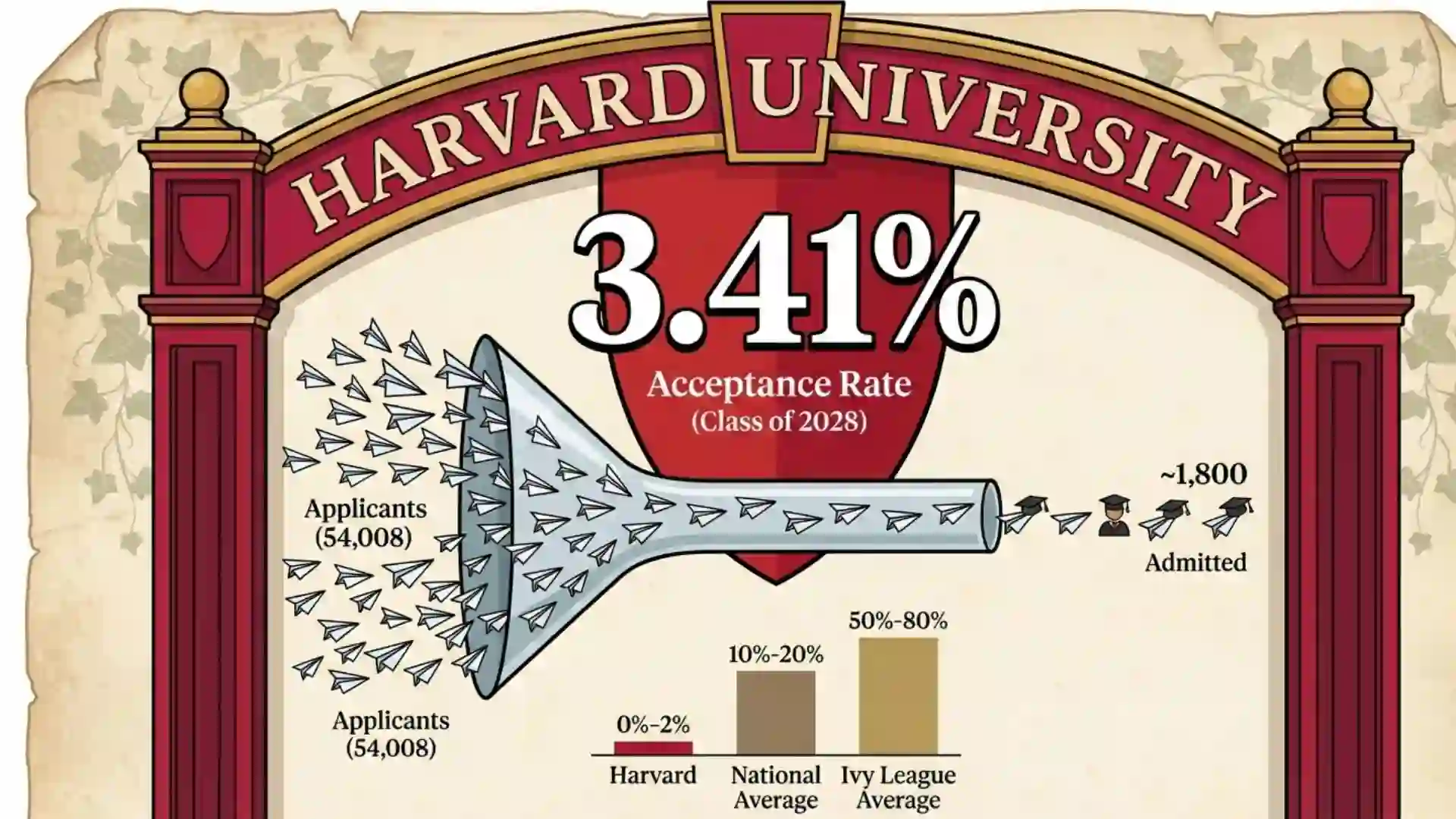
Harvard Acceptance Rate: Harvard University is one of the most prestigious institutions in the world. Year after year, it attracts some of the brightest and most ambitious students from across the United States and around the world. As a result, the Harvard acceptance rate has become a subject of deep interest, curiosity, and sometimes anxiety for those considering applying.
In this article, we will take a comprehensive look at the Harvard acceptance rate—what it is, how it has changed over time, what it says about the competitive nature of admissions, how Harvard evaluates applicants, and what students can do to strengthen their chances. We will also include a structured table of important links and information to assist applicants, as well as a detailed FAQ (Frequently Asked Questions) section and a final conclusion that draws together all key points.
What Is the Harvard Acceptance Rate?
The Harvard acceptance rate refers to the percentage of applicants who are offered admission by Harvard University in a given admissions cycle. This rate is calculated by dividing the number of admitted students by the total number of applicants.
For example, if Harvard receives 50,000 applications in a year and offers admission to 2,000 students, the acceptance rate would be 4 percent. This number reflects how selective Harvard is as an institution. Historically, Harvard’s acceptance rate has been among the lowest of all colleges and universities in the United States.
The exact acceptance rate varies each year based on the number of applications Harvard receives and the number of students it chooses to admit. However, for many recent admissions cycles, the acceptance rate has hovered in the low single digits, reflecting a highly competitive process.
Why the Acceptance Rate Matters?
The Harvard acceptance rate is noted for several reasons:
- Indicator of Selectivity
Harvard’s reputation for selectivity is partly driven by its low acceptance rate. A lower rate suggests that the university admits a very small proportion of those who apply. - Measure of Demand
The acceptance rate also reflects how many students want to attend Harvard. A high volume of applications increases competition and often results in a lower acceptance rate. - Benchmark for Applicants
Prospective students often use acceptance rate statistics to gauge their chances of admission and to decide where to apply.
However, it is important to understand what the acceptance rate does not measure. It does not indicate student quality, potential for success, or the exact likelihood for any individual applicant. Admissions decisions are personal and based on many factors beyond simple numerical statistics.
How the Harvard Acceptance Rate Has Changed Over Time?
Over the past several decades, the Harvard acceptance rate has generally declined. In earlier times, when fewer students applied to elite universities, acceptance rates were higher. But in recent years, particularly in the 2000s and 2010s, the number of applicants to Harvard exploded due to several factors:
- Increased global awareness of Harvard’s academic reputation
- Greater access to college counseling and application platforms
- The rise of online college application systems like the Common Application
- A broader pool of international applicants
As these forces increased the volume of applications, Harvard did not proportionately expand its admitted class size. This mismatch between rising applications and relatively stable class size contributed to a shrinking acceptance rate.
In earlier decades, acceptance rates at elite universities like Harvard were often in the double digits. In recent years, however, Harvard’s rate has consistently fallen into the single digits. These changes reflect broader trends in higher education and demonstrate the extremely competitive landscape applicants face today.
What Influences Harvard’s Admissions Decisions?
Harvard uses a holistic admissions process, which means that it evaluates applicants on a wide range of criteria—not simply on grades or test scores. Holistic review considers the student as a whole person: their achievements, character, background, experiences, potential, and the contributions they might make to the college community.
Below are major elements that Harvard typically considers:
Academic Excellence
While Harvard does not publish strict cutoffs for grades or test scores, academic achievement is a crucial component of any applicant’s profile. This includes:
- Course rigor in high school
- Grades and GPA
- Class rank (if applicable)
- Standardized test scores (where submitted)
Grades tell admissions officers that the student has performed well in a challenging academic environment.
Letters of Recommendation
Teachers and guidance counselors write letters that provide context for the applicant’s performance and potential. Strong recommendations often speak to the applicant’s character, intellectual curiosity, and ability to thrive in a university setting.
Personal Essays
Essays allow applicants to share their voice, tell their story, and communicate their interests, motivations, and values. Admissions officers often look for depth, reflection, and authenticity in essay responses.
Extracurricular Activities
Harvard evaluates students on the quality of their extracurricular involvement. Leadership, impact, dedication, and initiative are often more significant than merely listing activities. These may include:
- Clubs and organizations
- Community service
- Sports
- Arts and performance
- Research and internships
Special Talents and Background
Harvard seeks to build a diverse class with varying perspectives and experiences. Special talents, geographic background, socioeconomic background, first-generation college status, or unique life experiences can influence admission decisions.
Contextual Evaluation
Admissions officers consider the context in which students achieved their accomplishments. This might include socioeconomic factors, resources available, family responsibilities, or challenges overcome.
How Harvard’s Holistic Review Works?
Harvard’s holistic admissions process does not rely on a strict formula or numerical point system. Instead, admissions committees consider patterns and narratives within applications. They aim to build a class that is not only academically strong but also diverse, engaged, and capable of contributing to the campus community.
This means that two applicants with similar grades and scores might receive different decisions because of other elements in their application such as essays, recommendations, or personal background.
The holistic review process also means Harvard seeks a balance of students who bring different strengths—academic, artistic, athletic, leadership-driven, community-focused, or otherwise.
Early Action and Regular Decision
Harvard offers a Restrictive Early Action (REA) option, which allows students to apply early and receive an early decision. This is not binding, meaning students are not required to enroll if admitted. Early Action can be a strategic choice for students who have prepared a strong application early.
However, the acceptance rate for Early Action is often lower than Regular Decision due to a larger concentration of highly competitive applicants.
Students who apply through Regular Decision typically have more time to craft their application but may face a slightly less selective pool relative to Early Action.
Deciding whether to apply Early Action or Regular Decision depends on individual readiness, completeness of application materials, and personal preference.
Interpreting the Acceptance Rate
A low acceptance rate, while impressive, is only one part of the admissions landscape. It does not mean that admission is impossible or that no one outside of a narrow profile is admitted. Many students with varied backgrounds, interests, talents, and stories are admitted each year.
Read the acceptance rate as a reflection of competition, not as a definitive prediction of any single applicant’s outcome.
The acceptance rate should be a motivator to build the strongest possible application rather than a deterrent that causes hesitation or discouragement.
Important Links and Information
The table below provides key links and helpful information for students preparing to apply to Harvard. These links point to official Harvard University resources or important topics that applicants should explore.
| Category | Link / Resource |
|---|---|
| Official Admissions Statistics | https://college.harvard.edu/admissions/admissions-statistics |
| Main Undergraduate Admissions Page | https://college.harvard.edu/admissions |
| Application Requirements Overview | See admissions site for details on essays, transcripts, recommendations, and deadlines |
| Restrictive Early Action Policy | Details available on Harvard admissions site |
| Financial Aid Information | Visit Harvard’s financial aid section for need-based aid policies |
| Contact Admissions Office | Contact information listed on official Harvard admissions page |
| Tips for Applying | See guidance and advice sections on admissions site |
Note: The above table lists categories and general links that applicants should explore on Harvard’s official website. Always refer to the official Harvard University site for the most accurate and current information.
Tips for Strengthening Your Application
Although no strategy guarantees admission to Harvard, there are several evidence-based approaches that can improve your chances:
Focus on Academic Rigor
Take the most challenging courses available at your high school. A consistent pattern of academic excellence signals readiness for college-level work.
Develop Meaningful Extracurricular Involvement
Commit to activities that genuinely interest you and where you can demonstrate measurable impact. Depth and leadership often matter more than participation in many unrelated activities.
Write Thoughtful Essays
Invest time in crafting essays that reflect your personality, aspirations, and unique experiences. Clear, compelling writing that reveals your motivations can strengthen your application.
Request Strong Recommendations
Ask teachers or mentors who know you well and can provide specific insights into your character, growth, and potential. Generic or superficial letters are less impactful than those with thoughtful detail.
Demonstrate Backstory and Personal Growth
Harvard values students who have risen to challenges or brought passion and purpose to their pursuits. Share experiences that reveal resilience, motivation, and personal development.
Present a Cohesive Application
Ensure that all elements of your application tell a coherent story about who you are and what you value. Admissions officers look for narratives that convey direction, intent, and self-awareness.
FAQ about Harvard Acceptance Rate 2026
What Is Harvard’s Acceptance Rate?
Harvard’s undergraduate acceptance rate has been historically low, often falling in the single-digit range. This reflects the number of admitted students relative to the total number of applicants.
Is the Acceptance Rate the Same Each Year?
No. The acceptance rate varies each year based on the number of applicants and institutional choices regarding the admitted class. However, Harvard’s rate has remained consistently low in recent admissions cycles.
Does Harvard Require Standardized Test Scores?
Harvard’s policy on standardized test scores has evolved over time. Applicants should refer to Harvard’s official admissions website for current requirements related to standardized tests.
Is Applying Early Action Better?
Early Action may be more competitive but offers the benefit of an early decision. Students should apply Early Action only if their applications are complete and strong by the early deadline.
Does Harvard Offer Financial Aid?
Yes. Harvard provides need-based financial aid and seeks to meet the demonstrated financial need of admitted students. Detailed information is available on the university’s financial aid site.
Can International Students Apply?
Absolutely. Harvard welcomes applications from international students and evaluates them through the same holistic admissions process.
What Does Holistic Admissions Mean?
Holistic admissions means evaluating an applicant’s academic record alongside personal qualities, experiences, essays, recommendations, extracurricular involvement, and overall context.
Conclusion
The Harvard acceptance rate is one of the most talked-about statistics in college admissions. With a consistently low rate, it reflects the intense competition and high volume of applicants seeking admission each year.
Yet the acceptance rate should not be viewed as an impenetrable barrier. It is a metric that reflects both Harvard’s selectivity and the growing demand among students worldwide. Importantly, acceptance rates do not predict the outcome for any single applicant; rather, they serve as context for the competitive landscape.
Harvard’s holistic admissions process means that many factors—academic performance, personal essays, extracurricular involvement, recommendations, and unique personal experiences—are evaluated together. This creates opportunities for students with diverse backgrounds and stories to be admitted.
Prospective applicants should focus on crafting the strongest possible application based on their interests, strengths, and goals. By understanding the nature of the admissions process and preparing strategically, applicants can approach their application with confidence and clarity.
For accurate and updated statistics, always visit Harvard’s official admissions statistics page:
https://college.harvard.edu/admissions/admissions-statistics