The term “ivy league schools” is recognized around the world as a symbol of academic excellence, prestige, selective admissions, influential alumni, and historic traditions. Students from every country dream of attending these universities because they are known for world-class education, outstanding faculty, research opportunities, powerful networking connections, and strong career outcomes.
The Ivy League is not just about academics. These universities also represent history, culture, leadership, innovation, athletics, and social influence. Graduates from Ivy League schools have become presidents, Nobel Prize winners, CEOs, scientists, judges, entrepreneurs, authors, and global leaders.
In this detailed guide, you will learn what ivy league schools are, which universities belong to the Ivy League, their history, admission requirements, tuition costs, acceptance rates, student life, career opportunities, and much more.
What Are Ivy League Schools?
The phrase “ivy league schools” refers to a group of eight private universities located in the northeastern United States. Originally, the Ivy League was formed as an athletic conference, but over time these institutions became internationally famous for their academic reputation and influence.
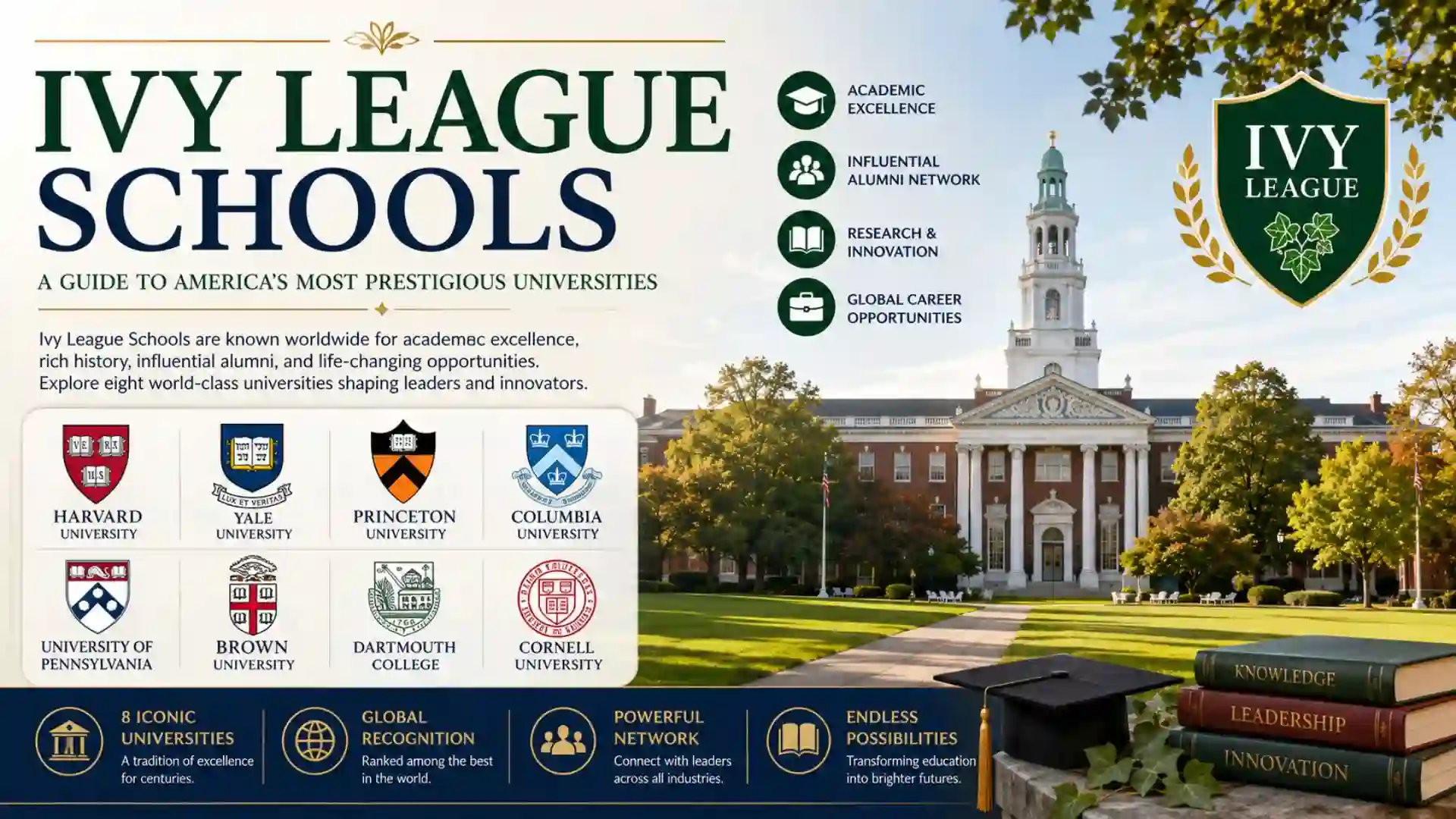
The eight Ivy League schools are:
- Harvard University
- Yale University
- Princeton University
- Columbia University
- University of Pennsylvania
- Brown University
- Dartmouth College
- Cornell University
These universities are among the most selective educational institutions in the world. Admission is extremely competitive because thousands of highly qualified students apply every year.
History of Ivy League Schools
The history of ivy league schools goes back hundreds of years. Most of these universities were founded before the American Revolution. They played major roles in shaping education in the United States.
The term “Ivy League” became officially associated with athletics in 1954, but the universities had already built strong reputations long before then.
Here is a brief historical overview:
- Harvard University was founded in 1636 and is the oldest university in the United States.
- Yale University was established in 1701.
- Princeton University began in 1746.
- Columbia University was founded in 1754.
- Brown University started in 1764.
- Dartmouth College was founded in 1769.
- University of Pennsylvania was established by Benjamin Franklin.
- Cornell University was founded later in 1865 but quickly gained prestige.
These universities developed traditions of academic rigor, leadership, and intellectual achievement that continue today.
List of Ivy League Schools
| University | Founded | Location | Known For |
|---|---|---|---|
| Harvard University | 1636 | Cambridge, Massachusetts | Law, business, medicine |
| Yale University | 1701 | New Haven, Connecticut | Humanities, law, drama |
| Princeton University | 1746 | Princeton, New Jersey | Mathematics, public policy |
| Columbia University | 1754 | New York City, New York | Journalism, business |
| University of Pennsylvania | 1740 | Philadelphia, Pennsylvania | Business, finance |
| Brown University | 1764 | Providence, Rhode Island | Open curriculum |
| Dartmouth College | 1769 | Hanover, New Hampshire | Liberal arts |
| Cornell University | 1865 | Ithaca, New York | Engineering, hospitality |
Why Ivy League Schools Are So Famous?
There are several reasons why ivy league schools are respected globally.
Academic Excellence
These universities consistently rank among the best in the world. They attract top professors, researchers, and scholars.
Selective Admissions
Admission rates are extremely low. Only a small percentage of applicants are accepted each year.
Strong Alumni Networks
Graduates often become leaders in business, politics, science, law, entertainment, and technology.
Research Opportunities
Students have access to advanced laboratories, libraries, and funding opportunities.
Career Advantages
Employers highly value Ivy League degrees. Many graduates receive strong job offers and internships.
Historical Prestige
These institutions have centuries of history and tradition.
Harvard University
Harvard University is often considered the most famous among ivy league schools. Located in Cambridge, Massachusetts, Harvard is known for its academic reputation, influential alumni, and research programs.
Harvard offers programs in business, medicine, law, engineering, arts, and sciences. The university has one of the largest academic libraries in the world.
Notable alumni include presidents, Nobel Prize winners, billionaires, and global leaders.
Popular Programs at Harvard
- Business Administration
- Law
- Medicine
- Political Science
- Economics
- Computer Science
Yale University
Yale University is known for its strong humanities programs, law school, and arts education. Located in New Haven, Connecticut, Yale has a beautiful historic campus and a vibrant student culture.
The university is famous for theater, music, literature, and political science.
Popular Programs at Yale
- Law
- Drama
- History
- Political Science
- Literature
- Music
Princeton University
Princeton University is highly respected for mathematics, engineering, public policy, and scientific research.
Princeton focuses strongly on undergraduate education and maintains small class sizes.
Popular Programs at Princeton
- Mathematics
- Physics
- Public Policy
- Economics
- Engineering
- Computer Science
Columbia University
Located in New York City, Columbia University provides students with access to one of the world’s most influential cities.
Columbia is especially known for journalism, international affairs, medicine, and business.
Popular Programs at Columbia
- Journalism
- Business
- International Relations
- Medicine
- Film Studies
- Economics
University of Pennsylvania
The University of Pennsylvania, often called UPenn, is famous for the Wharton School of Business.
Founded by Benjamin Franklin, the university combines liberal arts education with professional studies.
Popular Programs at UPenn
- Finance
- Business
- Nursing
- Engineering
- Economics
- Political Science
Brown University
Brown University is known for its open curriculum, which allows students to design their own educational paths.
Students at Brown enjoy academic flexibility and interdisciplinary learning.
Popular Programs at Brown
- Computer Science
- Literature
- Public Health
- Biology
- International Relations
- Psychology
Dartmouth College
Dartmouth College is smaller than many ivy league schools and is known for its close-knit community.
The college emphasizes undergraduate education and liberal arts learning.
Popular Programs at Dartmouth
- Government
- Economics
- Engineering
- Medicine
- Environmental Studies
- Psychology
Cornell University
Cornell University is the largest Ivy League institution and offers a broad range of programs.
It is especially known for engineering, architecture, hotel management, and agriculture.
Popular Programs at Cornell
- Engineering
- Hospitality Management
- Architecture
- Agriculture
- Computer Science
- Business
Ivy League Schools Acceptance Rates
One reason ivy league schools are so prestigious is their highly competitive admissions process.
Acceptance rates generally range from around 3% to 10%, depending on the university and application cycle.
| University | Approximate Acceptance Rate |
|---|---|
| Harvard University | 3%–4% |
| Yale University | 4%–5% |
| Princeton University | 4%–5% |
| Columbia University | 4% |
| University of Pennsylvania | 5%–6% |
| Brown University | 5%–6% |
| Dartmouth College | 6% |
| Cornell University | 7%–9% |
Students need outstanding academic records, strong extracurricular activities, leadership experience, essays, recommendations, and test scores to be competitive applicants.
Admission Requirements for Ivy League Schools
Although each university has its own process, most ivy league schools evaluate applicants using similar criteria.
Strong Academic Performance
Students are expected to earn excellent grades in challenging courses.
Standardized Test Scores
Many universities have test-optional policies, but strong SAT or ACT scores can strengthen applications.
Extracurricular Activities
Leadership roles, volunteer work, athletics, music, research, or entrepreneurship can improve an application.
Personal Essays
Essays help admissions officers understand a student’s personality, goals, and values.
Recommendation Letters
Teachers and counselors provide insights into a student’s abilities and character.
Interviews
Some Ivy League schools offer alumni interviews as part of the process.
Tuition Costs at Ivy League Schools
Studying at ivy league schools can be expensive. Tuition, housing, meals, books, and other costs may exceed $80,000 per year.
However, these universities also provide generous financial aid packages.
| University | Estimated Annual Cost |
|---|---|
| Harvard University | $80,000+ |
| Yale University | $84,000+ |
| Princeton University | $79,000+ |
| Columbia University | $85,000+ |
| University of Pennsylvania | $88,000+ |
| Brown University | $84,000+ |
| Dartmouth College | $83,000+ |
| Cornell University | $82,000+ |
Many students receive scholarships or need-based financial aid that significantly reduces costs.
Financial Aid and Scholarships
One important fact about ivy league schools is that many offer need-based aid rather than merit scholarships.
This means financial assistance depends on family income and financial circumstances.
Some Ivy League universities have policies where students from lower-income families can attend with little or no tuition cost.
Financial aid may include:
- Grants
- Scholarships
- Work-study programs
- Student employment
- Loans
Student Life at Ivy League Schools
Student life at ivy league schools combines academics, social activities, athletics, research, and networking opportunities.
Campus Traditions
Each university has unique traditions, ceremonies, and student events.
Clubs and Organizations
Students can join debate teams, cultural organizations, research groups, business clubs, music ensembles, and sports teams.
Athletics
Although the Ivy League is academically focused, athletics remain important. Schools compete in NCAA Division I sports.
Housing and Dining
Students often live on campus and participate in residential communities.
Diversity
Students come from many countries and backgrounds, creating international learning environments.
Career Opportunities After Graduation
Graduates from ivy league schools often receive strong career opportunities due to the universities’ reputations and alumni networks.
Common Career Fields
- Finance
- Law
- Medicine
- Technology
- Consulting
- Government
- Research
- Entrepreneurship
Many top companies actively recruit students from Ivy League campuses.
Ivy League Schools vs Other Universities
Many people wonder whether ivy league schools are automatically better than all other universities.
The answer depends on a student’s goals, interests, budget, and career plans.
There are many outstanding universities outside the Ivy League, including:
- Stanford University
- Massachusetts Institute of Technology
- University of Chicago
- Duke University
- California Institute of Technology
Some non-Ivy universities may be stronger in specific fields than Ivy League institutions.
Are Ivy League Schools Worth It?
For many students, attending an Ivy League university can provide major advantages.
Potential Benefits
- Prestigious degree
- Excellent faculty
- Global recognition
- Strong alumni network
- Career opportunities
- Research access
Potential Challenges
- Intense competition
- High stress
- Expensive costs
- Competitive environment
Students should consider personal fit rather than prestige alone.
How to Get Into Ivy League Schools?
Students hoping to attend ivy league schools should focus on building strong academic and personal profiles.
Tips for Applicants
Maintain Excellent Grades
Take challenging courses and perform consistently well.
Develop Leadership Skills
Participate in clubs, organizations, sports, or community activities.
Build a Unique Profile
Admissions officers appreciate students with specific passions and achievements.
Write Strong Essays
Authentic personal stories can make applications memorable.
Prepare for Interviews
Practice discussing goals, interests, and experiences confidently.
Apply Strategically
Research each university carefully before applying.
Common Myths About Ivy League Schools
Myth 1: Only Rich Students Attend
Many Ivy League schools provide significant financial aid.
Myth 2: You Must Be Perfect
Students do not need perfect grades in every area, but they should demonstrate excellence and potential.
Myth 3: Ivy League Guarantees Success
Success depends on individual effort, skills, and opportunities.
Myth 4: All Ivy League Schools Are the Same
Each university has a unique culture, academic focus, and campus environment.
International Students and Ivy League Schools
International students make up an important part of Ivy League communities.
These students often bring global perspectives and diverse experiences.
International applicants typically need:
- English language proficiency tests
- Academic transcripts
- Financial documentation
- Essays and recommendations
Competition for international admissions is often very strong.
Online Programs and Continuing Education
Some ivy league schools offer online courses, certificate programs, and continuing education opportunities.
These programs help professionals and lifelong learners gain advanced knowledge without full-time enrollment.
Popular online learning areas include:
- Business
- Data science
- Computer programming
- Healthcare
- Leadership
- Finance
The Future of Ivy League Schools
Ivy League universities continue adapting to changes in technology, research, globalization, and student needs.
Future trends may include:
- Expanded online learning
- Increased focus on diversity
- Greater interdisciplinary research
- Advanced artificial intelligence programs
- Sustainability initiatives
These institutions are expected to remain influential in global education for decades to come.
Important Links and Information
| Topic | Information |
|---|---|
| Number of Ivy League Schools | 8 |
| Oldest Ivy League School | Harvard University |
| Most Recent Ivy League School Founded | Cornell University |
| Primary Region | Northeastern United States |
| Known For | Academic excellence and prestige |
| Athletic Conference Established | 1954 |
| Common Degree Levels | Undergraduate, graduate, doctoral |
| Financial Aid Availability | Extensive need-based aid |
| Typical Admission Difficulty | Extremely competitive |
| Average Student Population | Varies by university |
| International Recognition | Very high |
| Common Career Outcomes | Finance, law, medicine, technology |
| Student Activities | Athletics, clubs, research |
| Research Opportunities | Extensive |
| Campus Types | Urban, suburban, rural |
FAQ about Ivy League Schools
What are ivy league schools?
Ivy league schools are eight prestigious private universities located in the northeastern United States.
Which Ivy League school is the hardest to get into?
Harvard, Columbia, and Princeton are often among the most selective based on acceptance rates.
Are ivy league schools expensive?
Yes, tuition and living costs are high, but many schools provide generous financial aid.
Can international students apply to Ivy League schools?
Yes, international students are welcome and form a significant part of the student population.
Do Ivy League schools offer scholarships?
Most Ivy League schools provide need-based financial aid instead of merit scholarships.
Is an Ivy League degree worth it?
For many students, the education, networking, and career opportunities make it valuable.
Which Ivy League school is best for business?
The University of Pennsylvania’s Wharton School is highly respected for business education.
Which Ivy League school is best for engineering?
Cornell University and Princeton University are especially known for engineering.
Are Ivy League schools only for wealthy students?
No, many students receive financial aid packages that make attendance affordable.
What GPA is needed for Ivy League schools?
Most admitted students have extremely high GPAs and rigorous coursework.
Conclusion
Ivy league schools represent some of the most respected and competitive universities in the world. These institutions combine academic excellence, historic traditions, influential alumni networks, advanced research opportunities, and strong career outcomes.
Although gaining admission is extremely challenging, students who are motivated, academically strong, and actively involved in meaningful activities can become competitive applicants. However, choosing a university should not depend only on prestige. Students should consider academic interests, campus culture, financial costs, career goals, and personal fit.
Whether your dream is to study business at the University of Pennsylvania, law at Yale, engineering at Cornell, or liberal arts at Dartmouth, ivy league schools continue to shape leaders and innovators across the globe.