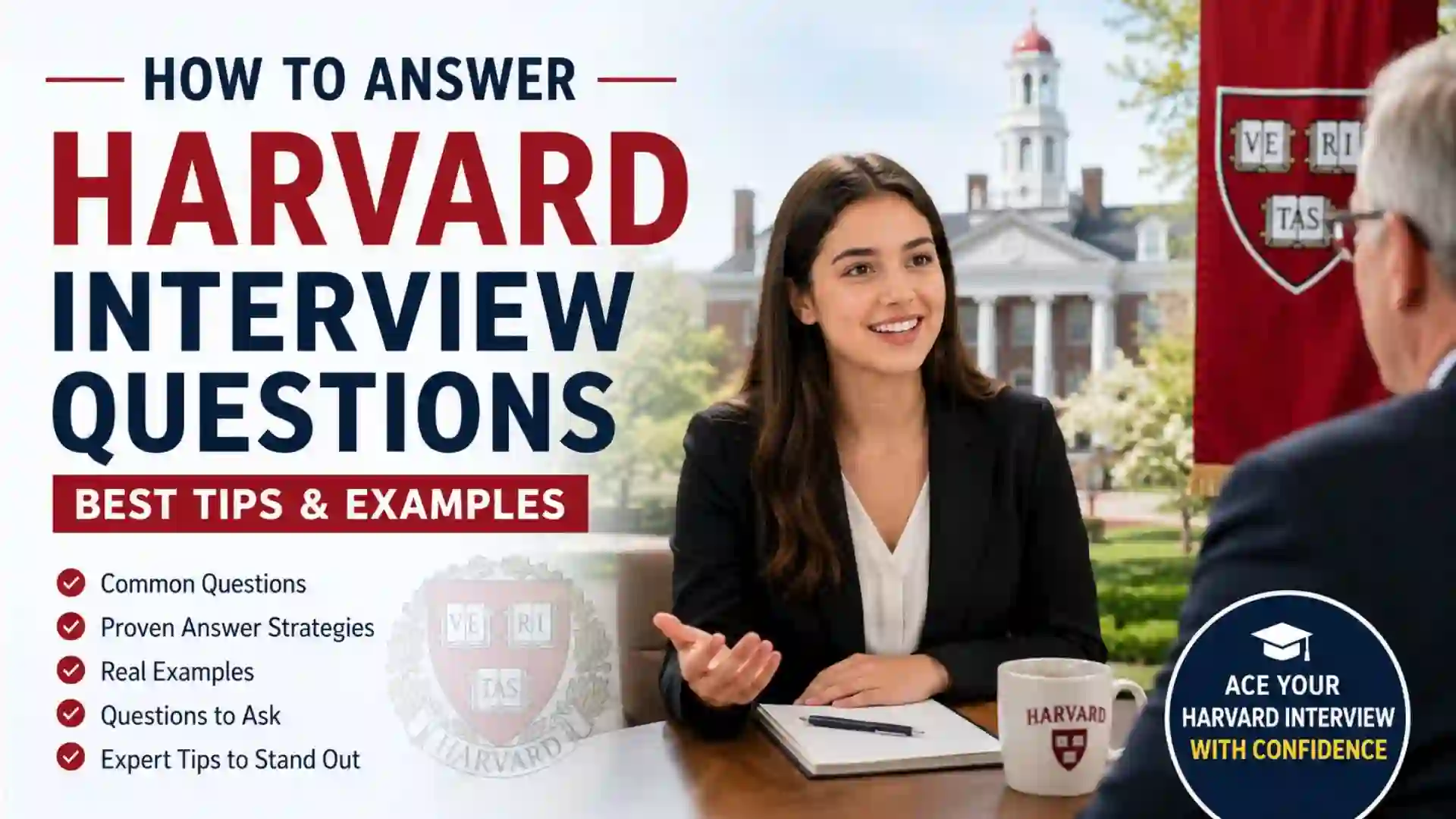
How to Answer Harvard Interview Questions: Preparing for a Harvard interview can feel intimidating, especially when you know that every conversation may seem important. However, the best way to approach a Harvard interview is not to memorize perfect answers. Instead, you should prepare to have a thoughtful, natural conversation about your interests, experiences, goals, values, and reasons for wanting to attend Harvard.
Harvard College explains that alumni interviews are assigned at the discretion of the Admissions Committee, partly based on the availability of alumni interviewers in a student’s area. Not every applicant will receive an interview, and Harvard states that an application is considered complete and receives full consideration even without an interview.
Harvard also emphasizes that there is no single type of ideal applicant. The admissions process considers academic achievement along with extracurricular activities, personal qualities, life experiences, perspectives, talents, and the potential to contribute to the Harvard community.
That means your goal should not be to sound like a stereotypical Harvard student. Your goal should be to help the interviewer understand who you are.
What Is a Harvard Interview?
A Harvard College interview is generally a conversation between an applicant and a Harvard alumnus or alumna. Depending on circumstances, interviews may take place virtually, by telephone, or in person. Harvard notes that alumni interviewers generally have access to the applicant’s name, contact information, and high school information rather than the applicant’s complete application.
This is important because you should not assume that your interviewer has already read everything you submitted.
The interview can therefore be an opportunity to explain your interests and experiences in your own words.
A Harvard interview is not simply a test where you must provide the “correct” answer to every question. It is better understood as a conversation designed to give the interviewer more insight into your personality, intellectual interests, experiences, communication style, and aspirations.
Important Harvard Interview Information
| Topic | Important Information |
|---|---|
| Interview format | May be virtual, by telephone, or in person depending on circumstances |
| Interviewer | Usually a Harvard alumnus or alumna |
| Is an interview guaranteed? | No |
| Can applicants request an interview? | Harvard says applicants cannot request one |
| Is the application complete without an interview? | Yes |
| Should you memorize answers? | No; prepare ideas and examples instead |
| Main goal | Communicate your personality, interests, experiences, and goals naturally |
| Good preparation | Review your application, experiences, interests, and reasons for Harvard |
| Questions to prepare | Personal, academic, extracurricular, Harvard-specific, and future-oriented questions |
| Questions for interviewer | Prepare several thoughtful questions about Harvard and the interviewer’s experience |
| Official admissions information | Harvard College Admissions |
For current application information, applicants should rely primarily on Harvard College’s official admissions website.
Why Authenticity Matters in a Harvard Interview?
One of the biggest mistakes applicants make is trying to sound impressive rather than trying to sound genuine.
Harvard’s own application guidance encourages students to write about things they genuinely care about instead of choosing topics simply because they believe the admissions committee wants to hear them. Harvard also states that the admissions process looks at the whole student.
The same principle is useful when preparing for an interview.
For example, imagine the interviewer asks:
“What subject could you talk about for hours?”
A weak answer might be:
“I am passionate about leadership, innovation, and changing the world.”
The answer sounds impressive, but it does not tell the interviewer much about you.
A stronger answer might be:
“I could probably talk for hours about how small websites grow through search engines. I started experimenting with SEO because I wanted to understand why some pages appeared above others. What began as curiosity eventually became a project where I tested different content structures and analyzed what happened.”
The second answer gives the interviewer something to explore.
It creates opportunities for follow-up questions.
That is exactly what you want.
How to Answer “Tell Me About Yourself”
This is one of the most common questions you should prepare for.
Do not give your entire life story.
Instead, create a concise introduction that connects three things:
- Who you are
- What interests you
- What you have done with those interests
A useful structure is:
Present → Interest → Experience → Future direction
For example:
“I’m a student who has become increasingly interested in environmental science, particularly the relationship between urban development and water management. I first became interested in the subject after working on a school research project about flooding in my community. Since then, I’ve participated in environmental projects and started reading more about sustainable urban planning. At college, I want to explore the subject from both scientific and social perspectives.”
This answer is effective because it provides several possible directions for the conversation.
Avoid turning your introduction into a list of awards.
The interviewer can already see that you are accomplished. What they want to understand is the person behind those accomplishments.
How to Answer “Why Harvard?”
This is one of the most important questions to prepare for.
Do not answer:
“Harvard is the best university in the world.”
That statement does not explain why Harvard is right for you.
Instead, connect Harvard’s opportunities with your specific academic and personal interests.
A useful formula is:
Your interest + Harvard opportunity + Why the combination matters
For example:
“I’m interested in neuroscience, particularly how memory develops and changes. What attracts me to Harvard is the opportunity to explore that interest across different areas rather than treating it as a narrow subject. I want an education where I can combine scientific study with broader questions about psychology, human behavior, and society.”
The key is specificity.
Research Harvard’s academic programs, courses, student organizations, research opportunities, communities, and other resources that genuinely relate to your interests.
However, do not simply memorize names and repeat them.
Explain why those opportunities matter to you.
How to Answer “What Are Your Academic Interests?”
Harvard wants students who are intellectually curious.
You do not necessarily need to have your entire career planned.
Instead, demonstrate curiosity.
For example:
“I’m currently most interested in economics, but I’m particularly curious about how behavioral economics can explain decisions that traditional economic models don’t always predict. I haven’t decided exactly what I want to specialize in, which is actually one reason I’m excited about studying broadly.”
This is stronger than:
“I want to major in economics because I want to become successful.”
Try to explain what questions fascinate you.
How to Answer Questions About Your Extracurricular Activities?
Interviewers may ask:
- What activity has been most important to you?
- Which extracurricular activity are you most proud of?
- Tell me about your leadership experience.
- What did you learn from your activities?
- What impact did you have?
- What would you continue at Harvard?
Do not simply describe what you did.
Explain the story behind the activity.
A strong structure is:
Situation → Action → Challenge → Result → Lesson
Suppose you organized a tutoring program.
Instead of saying:
“I organized tutoring sessions for younger students.”
Say:
“I noticed that several younger students were struggling with mathematics, so I helped organize weekly tutoring sessions. Initially, attendance was inconsistent, so I changed the format and created shorter sessions focused on specific problems. Over time, participation increased. More importantly, I learned that leadership wasn’t simply about organizing people; it was about understanding why something wasn’t working and adapting.”
The second answer demonstrates initiative, problem-solving, reflection, and growth.
How to Answer “Tell Me About a Failure”
Do not try to convince the interviewer that you have never failed.
Everyone experiences setbacks.
The important part is what you learned.
A strong answer should include:
- What happened
- Your responsibility
- What went wrong
- What you learned
- What you changed afterward
For example:
“During my first major research project, I underestimated how long the data collection would take. I ended up rushing the final stage and wasn’t satisfied with the quality of the analysis. I initially focused on the time problem, but afterward I realized that the bigger issue was poor planning. Since then, I break large projects into smaller deadlines and build additional time into my schedule.”
This answer demonstrates self-awareness rather than perfection.
How to Answer “What Is Your Greatest Strength?”
Choose a strength that you can demonstrate with a real example.
Instead of saying:
“My greatest strength is leadership.”
Explain what leadership means in your behavior.
For example:
“One of my strengths is persistence. When I become genuinely interested in a problem, I tend to keep working on it even when the first approach doesn’t work. During a research project, I had to repeat part of the experiment several times because the results were inconsistent. Instead of abandoning the project, I investigated the possible causes and eventually changed the methodology.”
The example makes the strength believable.
How to Answer “What Is Your Weakness?”
Avoid fake weaknesses such as:
“I’m a perfectionist.”
That answer is extremely common and often sounds rehearsed.
Instead, choose a genuine but manageable weakness and explain how you are addressing it.
For example:
“I sometimes spend too much time trying to solve a problem independently before asking for help. I’ve realized that independence is useful, but refusing to ask questions can waste time. I’m now more conscious of setting a limit on how long I’ll work alone before discussing the problem with someone else.”
The important part is not the weakness itself.
It is your self-awareness and willingness to improve.
How to Answer Questions About Disagreement?
Harvard’s current application materials specifically ask applicants to describe a time when they strongly disagreed with someone, how they communicated or engaged with that person, and what they learned.
That makes respectful disagreement an important skill to practice.
If an interviewer asks about a disagreement, avoid making the other person look stupid.
Instead, demonstrate that you can listen.
A strong answer might follow this structure:
Different opinions → Conversation → Understanding → Reflection
For example:
“I disagreed with a teammate about how we should structure a project. Initially, I thought my approach was obviously better, but after discussing the reasons behind his proposal, I realized that he was prioritizing something I hadn’t considered. We eventually combined both approaches. The experience taught me that disagreement isn’t necessarily a problem; sometimes it exposes assumptions that neither person noticed.”
This demonstrates maturity.
How to Answer “What Would You Contribute to Harvard?”
Avoid saying:
“I will contribute my leadership and diversity.”
Instead, describe something concrete.
You might say:
“I would like to contribute by creating spaces where students from different academic backgrounds can collaborate. In school, I enjoyed working on projects where students interested in technology, writing, and social issues approached the same problem differently. I’d like to continue that kind of collaboration in college.”
The answer should show what you have already done, not merely what you hope to claim.
How to Answer “What Do You Do Outside School?”
This question gives you an opportunity to become more memorable.
Do not assume every answer needs to sound academically impressive.
If you love photography, cooking, football, gaming, music, repairing electronics, reading science fiction, or another hobby, talk about it.
For example:
“I spend a lot of my free time photographing ordinary places around my town. I initially liked photography because of the visual side, but I eventually became interested in how changing the angle or timing can completely change the story of the same place.”
A genuine hobby can reveal curiosity and personality.
How to Answer Unexpected Harvard Interview Questions?
You may encounter questions that you did not specifically prepare for.
Do not panic.
The interviewer is not necessarily looking for a perfect answer.
Take a moment to think.
You can say:
“That’s an interesting question. Let me think about that for a second.”
Then organize your thoughts.
If you do not know something, you can say:
“I don’t know enough about that to give you a confident answer, but my initial thought would be…”
That is usually better than inventing an answer.
How to Handle Follow-Up Questions?
A Harvard interview can become conversational.
The interviewer may take one sentence from your answer and ask another question.
For example:
Interviewer: “You mentioned that you started a community project. Why did you start it?”
You: Give your answer.
Interviewer: “What was the biggest problem?”
You: Explain.
Interviewer: “What would you do differently?”
This is not something to fear.
It means the conversation is developing.
Listen carefully to each question instead of waiting to deliver a memorized response.
Questions You Should Ask Your Harvard Interviewer
At the end of the conversation, your interviewer may ask whether you have questions.
Always prepare several.
Good questions include:
- What was your experience like at Harvard?
- What surprised you most about Harvard?
- How did your academic interests change while you were there?
- What opportunities did you take advantage of outside the classroom?
- What do you wish you had known before starting at Harvard?
- What part of your Harvard experience has stayed with you the longest?
- How did your relationships with other students influence your experience?
Avoid asking questions that can easily be answered on Harvard’s website.
The best questions invite the interviewer to share personal experiences.
What Not to Do During a Harvard Interview?
Several mistakes can weaken an otherwise strong interview.
Do Not Memorize Entire Answers
Memorized responses can sound unnatural.
Prepare stories, examples, and key points instead.
Do Not Exaggerate
If you claim that an activity changed thousands of lives, be prepared to explain exactly what happened.
Honest details are more convincing than exaggerated achievements.
Do Not Turn Every Answer Into an Achievement
You are more than your awards.
Talk about curiosity, mistakes, hobbies, relationships, challenges, and experiences.
Do Not Talk Too Much
Answer the question directly.
A strong answer does not need to last five minutes.
Give the interviewer room to ask follow-up questions.
Do Not Speak Negatively About Other People
You can discuss disagreements and difficult experiences without attacking teachers, classmates, competitors, or organizations.
Do Not Pretend to Know Everything
Intellectual humility can be valuable.
If you do not know something, acknowledge it and explain how you would approach learning about it.
How to Prepare One Week Before the Interview?
A week before the interview, review your application and identify the major stories you want to be able to discuss.
Create a list of:
- Three academic interests
- Three important extracurricular experiences
- Two meaningful challenges
- One failure
- One accomplishment
- One experience that changed your perspective
- Several personal interests or hobbies
- Your reasons for applying to Harvard
- Your future goals
- Five questions for the interviewer
Do not write complete scripts.
Instead, write short notes.
This gives you structure without making your answers sound rehearsed.
How to Practice Harvard Interview Questions?
Practice speaking rather than simply writing answers.
You can practice with:
- A teacher
- A counselor
- A parent
- A friend
- A person who does not know your application well
The fifth option can be particularly useful because it shows whether your explanations make sense to someone unfamiliar with your background.
Record a practice interview if possible.
Then evaluate:
- Did I answer the actual question?
- Did I speak too quickly?
- Did I give specific examples?
- Did I sound natural?
- Did I explain what I learned?
- Did I interrupt?
- Did I ask thoughtful questions?
- Did I spend too much time discussing achievements?
The goal is improvement, not memorization.
Sample Harvard Interview Questions
Here are questions you should consider practicing:
| Category | Practice Questions |
| Introduction | Tell me about yourself. |
| Academic | What subject interests you most? |
| Curiosity | What topic could you talk about for hours? |
| Harvard | Why do you want to attend Harvard? |
| Activities | Which extracurricular activity matters most to you? |
| Leadership | Tell me about a time you led others. |
| Failure | Tell me about a time you failed. |
| Challenge | What is one difficult experience you have faced? |
| Disagreement | Tell me about a disagreement and what you learned. |
| Personality | What is something people often misunderstand about you? |
| Community | What would you contribute to Harvard? |
| Future | What do you hope to accomplish in the future? |
| Personal | What do you do for fun? |
| Reflection | What experience has changed your perspective? |
| Questions | What questions do you have for me? |
These should be treated as preparation prompts rather than a prediction of the exact questions your interviewer will ask.
Harvard Interview Preparation for International Students
International applicants should use the same basic strategy as other applicants: be authentic, specific, curious, and prepared to explain their experiences.
Harvard states that it welcomes applications from students around the world and that its admissions and financial aid processes apply regardless of nationality or citizenship.
If English is not your first language, do not try to use complicated vocabulary simply to sound impressive.
Clear communication is more important than sophisticated words.
For example, a simple statement such as:
“I became interested in economics after seeing how changes in food prices affected my family and community.”
can be more powerful than a complicated statement filled with technical terminology.
Your international background can naturally become part of your story when it is relevant to your experiences and perspective.
What Makes a Strong Harvard Interview Answer?
A strong answer usually contains at least one of these qualities:
Specificity: You provide a real example.
Reflection: You explain what you learned.
Curiosity: You demonstrate that you want to understand something more deeply.
Authenticity: Your answer sounds like you.
Self-awareness: You understand your strengths and limitations.
Growth: You demonstrate how an experience changed you.
Connection: You explain how an experience relates to your interests or future.
The strongest answers often combine several of these qualities.
A Simple Formula for Almost Any Interview Question
When you are unsure how to structure an answer, use this five-step approach:
1. Answer the question directly.
Start with your main point.
2. Give a specific example.
Explain what actually happened.
3. Describe your role.
Make clear what you personally did.
4. Reflect on the experience.
Explain what you learned.
5. Connect it to the future.
If appropriate, explain how the experience influences what you want to do next.
For example:
“I’m particularly interested in computer science because I enjoy solving problems where there isn’t an obvious answer. I discovered this while building a small application for a school project. The first version failed because I hadn’t considered how users would interact with it. After testing it with other students, I redesigned it. That experience taught me that programming isn’t only about writing code; it is also about understanding people. That’s one reason I’m interested in exploring human-computer interaction.”
This type of response gives the interviewer multiple ways to continue the conversation.
Final Tips for Answering Harvard Interview Questions
Before your interview, remember these principles:
- Be yourself rather than trying to imitate another applicant.
- Know your own experiences extremely well.
- Prepare stories instead of scripts.
- Use specific examples whenever possible.
- Explain what you learned from important experiences.
- Be ready to discuss both successes and failures.
- Show genuine intellectual curiosity.
- Listen carefully to the interviewer.
- Let the conversation develop naturally.
- Prepare thoughtful questions.
- Do not exaggerate your achievements.
- Do not panic when you receive an unexpected question.
Most importantly, remember that the interviewer is trying to learn about the person behind the application.
Harvard’s admissions guidance emphasizes that there is no typical Harvard student and no single ideal Harvard applicant. The university considers academic achievements alongside extracurricular activities, personal qualities, life experiences, perspectives, talents, and potential contributions to the community.
FAQ about How to Answer Harvard Interview Questions
Conclusion
Learning how to answer Harvard interview questions is less about finding perfect responses and more about learning how to communicate your story.
Prepare for questions about your academic interests, extracurricular activities, challenges, failures, strengths, goals, personal interests, reasons for choosing Harvard, and the contributions you hope to make. Build a collection of meaningful experiences that you can discuss naturally, but avoid memorizing complete answers.
The strongest Harvard interview responses are specific, honest, reflective, and personal. Instead of trying to prove that you are perfect, show how you think, what you care about, what you have learned, and what questions you want to explore next.
A Harvard interview should ultimately feel like a conversation rather than an examination. Prepare thoroughly, listen carefully, stay authentic, and give the interviewer a genuine understanding of who you are.
For official and current information about the Harvard application process and interviews, consult Harvard College Admissions and Harvard’s “What to Expect After You Apply” guide.