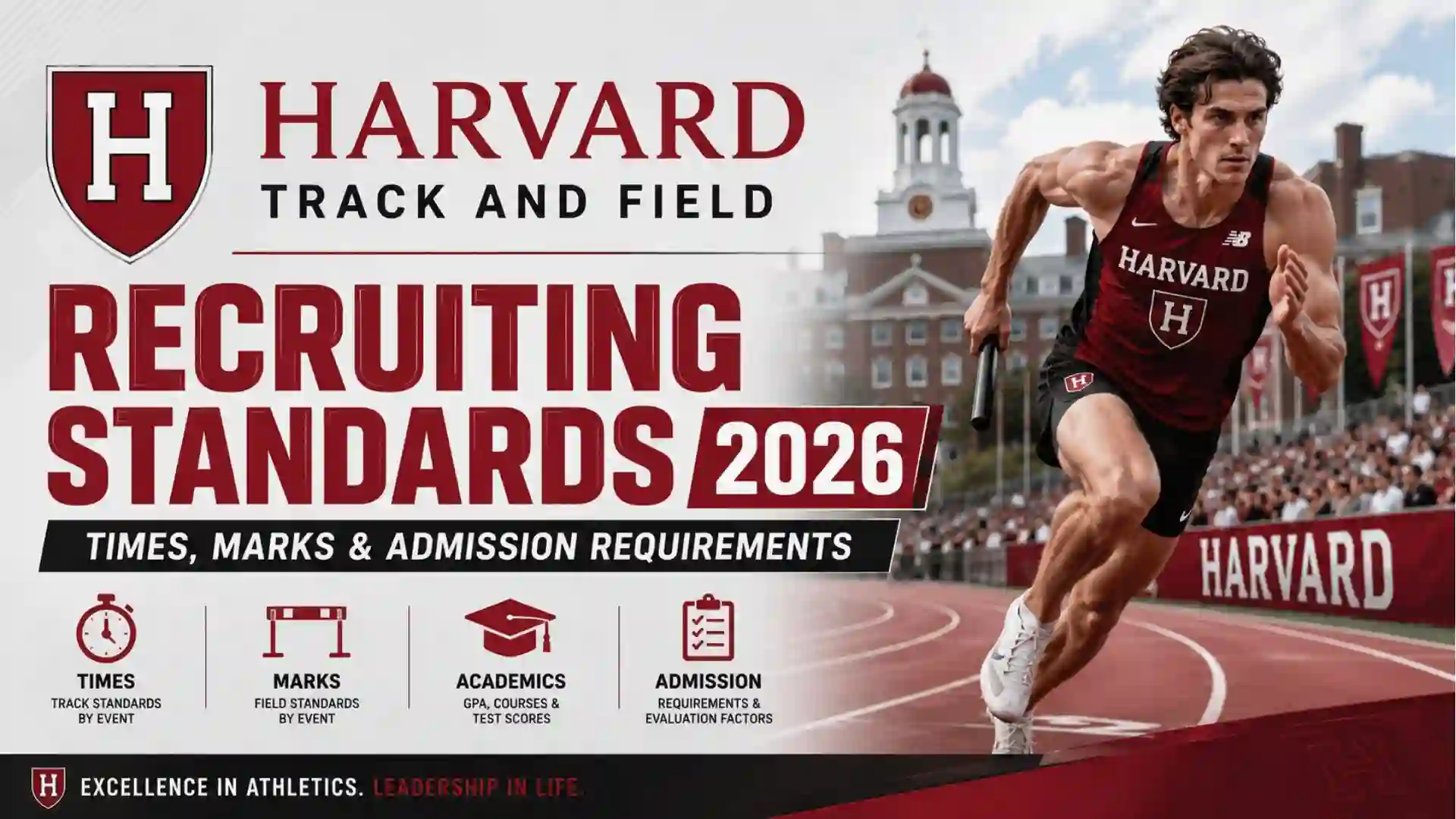
Harvard Track and Field Recruiting Standards: Harvard University is one of the most prestigious institutions in the world, attracting thousands of talented student-athletes every year. For track and field athletes, earning a recruitment opportunity from Harvard requires a combination of exceptional athletic performance, strong academic achievements, leadership qualities, and personal character. Understanding Harvard track and field recruiting standards can help prospective athletes evaluate their chances and create a realistic plan for becoming competitive candidates.
Unlike many athletic programs that publish strict recruiting benchmarks, Harvard follows a holistic recruiting process. Coaches evaluate athletes based on event performances, academic credentials, potential for improvement, and fit within the university’s culture. As a result, recruiting standards can vary from year to year depending on team needs and the strength of the recruiting class.
This comprehensive guide explains Harvard track and field recruiting standards, academic requirements, recruiting processes, scholarship information, and practical tips for aspiring student-athletes.
Overview of Harvard Track and Field Program
Harvard competes in NCAA Division I athletics and is a member of the Ivy League. The university sponsors both men’s and women’s track and field programs, including indoor and outdoor seasons.
Athletes compete in a wide variety of events, including:
- Sprints
- Hurdles
- Middle-distance running
- Long-distance running
- Steeplechase
- Relays
- High jump
- Pole vault
- Long jump
- Triple jump
- Shot put
- Discus
- Hammer throw
- Javelin
- Decathlon
- Heptathlon
The program consistently competes at a high level within the Ivy League and sends athletes to NCAA regional and national competitions.
Important Information and Links
| Information | Details |
|---|---|
| University Name | Harvard University |
| Athletic Division | NCAA Division I |
| Conference | Ivy League |
| Sport | Men’s and Women’s Track & Field |
| Athletic Scholarships | Not Offered by Ivy League Schools |
| Financial Aid | Need-Based Financial Aid Available |
| Recruiting Focus | Athletic Performance and Academic Excellence |
| Typical GPA Expectations | Very High Academic Standards |
| Standardized Tests | May be considered depending on admissions policies |
| Recruiting Contact Method | Online Recruiting Questionnaire and Coach Communication |
| Campus Location | Cambridge, Massachusetts, USA |
| Academic Reputation | One of the top universities globally |
| Team Competition Level | NCAA Division I |
| Recruiting Evaluation | Holistic Review Process |
Understanding Harvard Recruiting Standards
Many athletes search for exact recruiting standards, hoping to find specific times or distances that guarantee recruitment. In reality, Harvard coaches evaluate athletes relative to Ivy League competition and national-level high school performances.
Recruiting standards generally fall into three categories:
Minimum Interest Level
Athletes who achieve strong state-level performances may attract initial attention from coaches. These athletes are often invited to submit additional information, race results, and academic records.
Competitive Recruiting Level
Athletes with performances that rank among the best in their state or region often become legitimate recruiting prospects. Coaches may actively communicate with these athletes throughout the recruiting cycle.
Top Recruiting Level
Nationally ranked athletes, state champions, and athletes who compete at major national meets frequently receive significant interest from Harvard and other elite universities.
Typical Sprint Recruiting Standards
Sprinters must demonstrate exceptional speed to attract attention from Harvard coaches.
Competitive male sprinters often achieve:
| Event | Competitive Range |
|---|---|
| 100m | Approximately 10.5–11.0 seconds |
| 200m | Approximately 21.0–22.5 seconds |
| 400m | Approximately 47–50 seconds |
Competitive female sprinters often achieve:
| Event | Competitive Range |
|---|---|
| 100m | Approximately 11.7–12.3 seconds |
| 200m | Approximately 24–25.5 seconds |
| 400m | Approximately 54–58 seconds |
Athletes with faster performances generally become stronger recruiting candidates.
Middle-Distance Recruiting Standards
Middle-distance runners are highly valued because they can contribute in multiple events.
Men’s Events
| Event | Competitive Range |
|---|---|
| 800m | 1:50–1:56 |
| 1500m | 3:45–4:00 |
| Mile | 4:05–4:20 |
Women’s Events
| Event | Competitive Range |
|---|---|
| 800m | 2:08–2:16 |
| 1500m | 4:25–4:45 |
| Mile | 4:50–5:10 |
Athletes who perform well at national-level competitions often receive the most attention.
Distance Running Recruiting Standards
Distance runners often attract significant interest because of their ability to contribute during cross-country, indoor track, and outdoor track seasons.
Men’s Distance Events
| Event | Competitive Range |
|---|---|
| 3200m | 8:50–9:20 |
| 5000m | 14:20–15:00 |
| Cross Country | State and National-Level Success |
Women’s Distance Events
| Event | Competitive Range |
|---|---|
| 3200m | 10:15–11:00 |
| 5000m | 16:30–18:00 |
| Cross Country | State and National-Level Success |
Coaches often evaluate consistency, race strategy, and progression over time rather than relying solely on one performance.
Hurdles Recruiting Standards
Hurdlers who demonstrate technical efficiency and speed can become valuable recruits.
Men’s Hurdles
| Event | Competitive Range |
|---|---|
| 110m Hurdles | 13.8–15.0 seconds |
| 400m Hurdles | 51–55 seconds |
Women’s Hurdles
| Event | Competitive Range |
|---|---|
| 100m Hurdles | 13.5–14.8 seconds |
| 400m Hurdles | 58–63 seconds |
Jumping Event Recruiting Standards
Jumpers are evaluated based on consistency and championship-level performances.
Men’s Jumps
| Event | Competitive Range |
|---|---|
| Long Jump | 22–24+ feet |
| Triple Jump | 46–50+ feet |
| High Jump | 6’6″–7’0″ |
| Pole Vault | 15’0″–17’0″ |
Women’s Jumps
| Event | Competitive Range |
|---|---|
| Long Jump | 18–20+ feet |
| Triple Jump | 38–42+ feet |
| High Jump | 5’8″–6’0″ |
| Pole Vault | 12’0″–14’0″ |
Throwing Event Recruiting Standards
Throwers are often recruited based on state championships and national rankings.
Men’s Throws
| Event | Competitive Range |
|---|---|
| Shot Put | 55–65+ feet |
| Discus | 160–190+ feet |
| Hammer Throw | 180–220+ feet |
| Javelin | 190–230+ feet |
Women’s Throws
| Event | Competitive Range |
|---|---|
| Shot Put | 45–55+ feet |
| Discus | 140–170+ feet |
| Hammer Throw | 160–200+ feet |
| Javelin | 130–160+ feet |
Multi-Event Recruiting Standards
Athletes competing in decathlon and heptathlon events often attract interest because of their versatility.
Men’s Decathlon
Competitive recruits often score:
- 6,500 to 7,500+ points
Women’s Heptathlon
Competitive recruits often score:
- 4,500 to 5,500+ points
Academic Standards Matter Just as Much
Harvard is first and foremost an academic institution. Even elite athletes must meet demanding academic expectations.
Coaches evaluate:
- Grade Point Average (GPA)
- Course rigor
- Class rank
- Academic awards
- Standardized test scores when applicable
- Writing and communication skills
Students taking advanced coursework such as:
- AP Classes
- IB Programs
- Honors Courses
- Advanced Mathematics
- Laboratory Sciences
often strengthen their applications significantly.
The Academic Index
The Ivy League uses an academic evaluation system commonly known as the Academic Index.
This system helps ensure that recruited athletes can succeed academically at highly selective institutions.
Factors typically considered include:
- GPA
- Academic record
- Course difficulty
- Standardized testing where applicable
A strong athletic profile alone is generally insufficient for admission.
How Harvard Coaches Evaluate Recruits?
Coaches consider much more than raw performance numbers.
Important factors include:
Performance Progression
Athletes who improve consistently each year often attract greater attention than athletes who plateau early.
Championship Experience
Success in:
- State championships
- Regional championships
- National championships
demonstrates an athlete’s ability to perform under pressure.
Competitive Mindset
Coaches value athletes who:
- Work hard
- Handle adversity
- Demonstrate leadership
- Support teammates
Event Fit
Recruiting needs vary annually. Some years, coaches may prioritize distance runners, while other years they may focus on throwers or jumpers.
The Recruiting Process
Step 1: Build a Strong Athletic Resume
Include:
- Personal records
- Meet results
- Rankings
- Awards
- Academic information
Step 2: Contact Coaches
Send a professional email that includes:
- Name
- Graduation year
- Event specialties
- Personal records
- GPA
- Contact information
Step 3: Complete Recruiting Questionnaires
Most college programs provide recruiting forms that allow coaches to gather athlete information.
Step 4: Maintain Communication
Keep coaches updated regarding:
- New personal records
- Championship performances
- Academic achievements
Step 5: Campus Visits
Visits allow athletes to:
- Meet coaches
- Tour facilities
- Interact with team members
- Learn about academic programs
Step 6: Admissions Review
After coach support is secured, the admissions process becomes a critical component of recruitment.
Does Harvard Offer Athletic Scholarships?
One of the most misunderstood aspects of Ivy League recruiting involves scholarships.
Harvard does not offer athletic scholarships.
Instead, the university provides generous need-based financial aid.
Many families discover that Harvard’s financial aid packages can significantly reduce educational costs.
Financial aid decisions are based on family financial circumstances rather than athletic ability.
What Makes a Strong Harvard Recruit?
The strongest recruits often possess:
- Elite athletic performances
- Excellent academic records
- Leadership experience
- Community involvement
- Strong character references
- Consistent improvement
- Coachability
Athletes who excel in both academics and athletics stand out most during the recruiting process.
Common Mistakes Prospective Recruits Make
Focusing Only on Athletics
Strong grades remain essential.
Waiting Too Long to Contact Coaches
Early communication helps establish relationships.
Sending Incomplete Information
Provide comprehensive athletic and academic details.
Ignoring Academic Preparation
Harvard admissions standards remain extremely competitive.
Comparing Yourself Only to Published Standards
Recruiting decisions depend on many variables beyond performance metrics.
Tips for Increasing Recruitment Chances
Improve Academics
Strong grades open more opportunities.
Compete at Higher Levels
Seek opportunities at:
- State championships
- National meets
- Elite invitationals
Maintain Detailed Records
Track every significant performance and achievement.
Create Highlight Videos
Field event athletes especially benefit from quality video footage.
Build Relationships with Coaches
Professional communication can make a significant difference.
Demonstrate Leadership
Captains and team leaders often stand out during evaluations.
Life as a Harvard Track and Field Athlete
Student-athletes at Harvard balance demanding academics with elite athletic competition.
Benefits include:
- World-class education
- Elite coaching
- Outstanding facilities
- Extensive alumni network
- Leadership development opportunities
- Competitive NCAA Division I experience
Athletes learn time management, discipline, and teamwork while pursuing a degree from one of the world’s most respected universities.
FAQ about Harvard Track and Field Recruiting Standards
What are Harvard track and field recruiting standards?
Harvard track and field recruiting standards refer to the performance benchmarks and academic expectations that prospective student-athletes typically meet to be considered for recruitment. These standards vary by event and recruiting class, and coaches evaluate athletes based on both athletic achievements and academic qualifications.
Does Harvard publish official recruiting standards for track and field?
Harvard does not typically publish official recruiting standards for every event. Coaches use a holistic evaluation process that considers athletic performance, academic credentials, leadership qualities, and team needs.
What GPA is required for Harvard track and field recruitment?
There is no specific minimum GPA for recruited athletes, but successful candidates generally have excellent academic records. Most recruits have strong grades in challenging courses such as AP, IB, Honors, or advanced-level classes.
Does Harvard offer athletic scholarships for track and field?
No. As a member of the Ivy League, Harvard does not offer athletic scholarships. Instead, the university provides need-based financial aid to eligible students.
Can an athlete get into Harvard with average grades if they are exceptionally talented?
While exceptional athletic talent can strengthen an application, Harvard still expects recruits to meet rigorous academic standards. Coaches can support recruits during admissions, but academic performance remains a critical factor.
What track times are considered competitive for Harvard recruitment?
Competitive times vary by event and year. Generally, athletes who rank among the top performers in their state, region, or nationally have the strongest recruiting prospects.
When should athletes start contacting Harvard track and field coaches?
Athletes should begin researching and contacting coaches during their sophomore or junior year of high school. Early communication allows coaches to track development and build relationships with prospective recruits.
Conclusion
Harvard track and field recruiting standards extend far beyond specific times, distances, and heights. While strong athletic performances are essential, successful recruits must also demonstrate academic excellence, leadership, character, and long-term potential. The university seeks student-athletes who can thrive both on the track and in the classroom.
Prospective recruits should focus on continuous athletic improvement, maintain outstanding grades, communicate professionally with coaches, and pursue opportunities to compete at increasingly competitive levels. By combining elite athletic achievement with academic success, student-athletes can maximize their chances of earning serious consideration from Harvard’s track and field program.
Although no single performance guarantees recruitment, athletes who consistently perform at high levels while maintaining strong academic credentials place themselves in the best position to attract attention from Harvard coaches and admissions officials.