The question “what is the acceptance rate for Harvard” is one of the most searched topics among students planning to apply to elite universities. Harvard University is considered one of the most prestigious institutions in the world, attracting applicants from nearly every country. Because of its reputation, academic excellence, research opportunities, and influential alumni network, gaining admission to Harvard is extremely competitive.
Understanding the acceptance rate helps students evaluate their chances and prepare stronger applications. However, the acceptance rate alone does not fully explain how Harvard chooses students. Admissions decisions are based on multiple factors including academic performance, extracurricular achievements, essays, recommendations, leadership qualities, and personal background.
In this detailed guide, you will learn what is the acceptance rate for Harvard, how it changes each year, what affects the rate, how Harvard evaluates applicants, and strategies students can use to improve their chances of admission.
What Is Harvard University?
Harvard University is a private Ivy League research university located in Cambridge, Massachusetts, United States. Founded in 1636, it is the oldest higher education institution in the United States.
Harvard is globally known for:
- Academic excellence
- World-class faculty
- Outstanding research facilities
- Strong alumni network
- Prestigious professional schools
- Financial aid opportunities
The university includes several schools and colleges, including:
- Harvard College
- Harvard Business School
- Harvard Law School
- Harvard Medical School
- Harvard Kennedy School
Most students asking “what is the acceptance rate for Harvard” are referring to undergraduate admissions at Harvard College.
What Is the Acceptance Rate for Harvard?
The acceptance rate is the percentage of applicants who are admitted to the university.
The formula is simple:
Acceptance Rate = (Number of Students Admitted ÷ Total Number of Applicants) × 100
For example, if Harvard receives 50,000 applications and admits 2,000 students, the acceptance rate would be 4%.
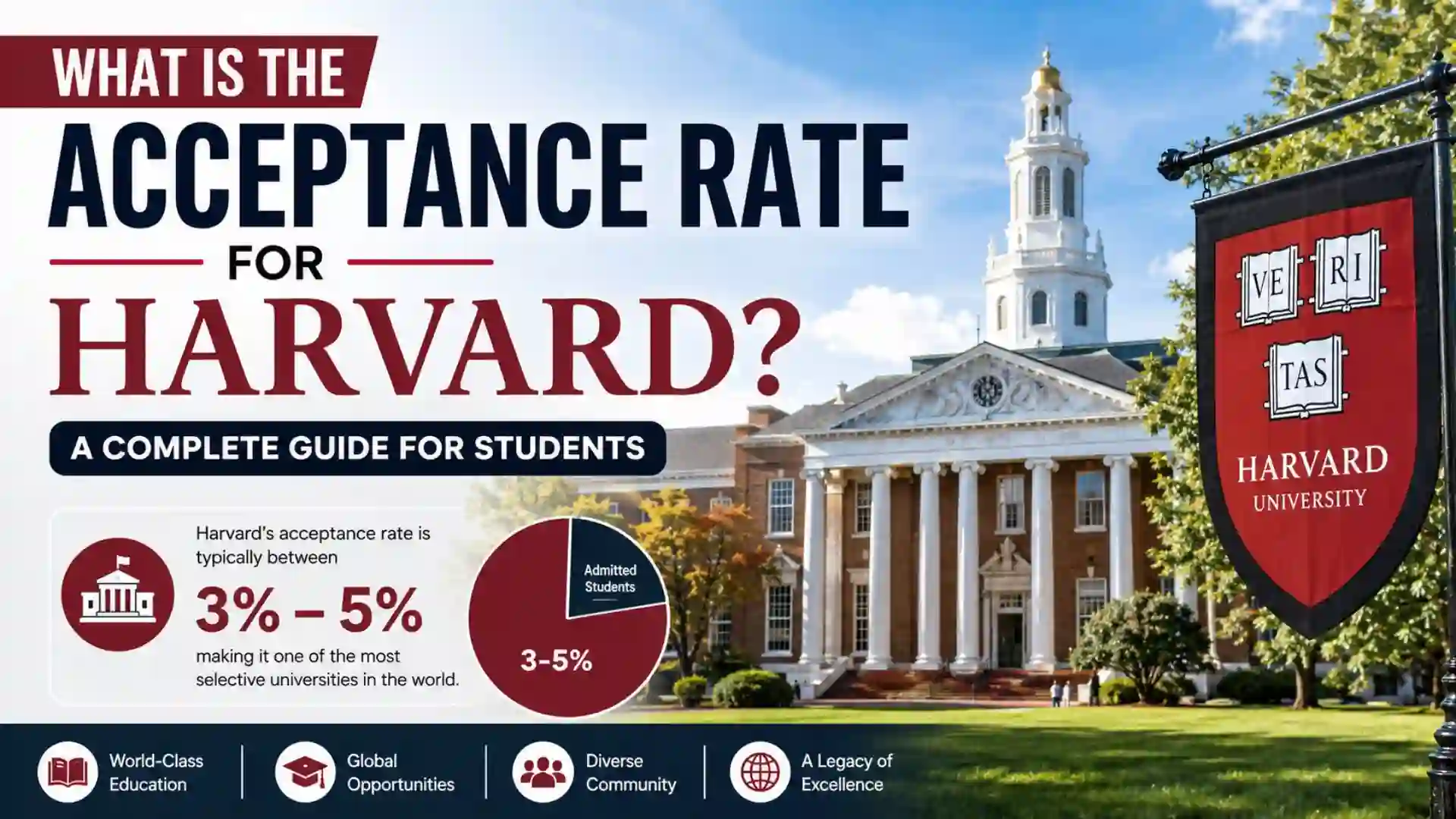
In recent years, Harvard’s acceptance rate has typically remained between 3% and 5%, making it one of the most selective universities in the world.
Harvard Acceptance Rate in Recent Years
The acceptance rate changes every year depending on:
- Number of applicants
- Number of available seats
- Admission policies
- Deferred admissions
- Yield rate
Below is a general overview of Harvard’s undergraduate acceptance rates in recent admission cycles.
| Admission Year | Approximate Applicants | Approximate Accepted Students | Acceptance Rate |
|---|---|---|---|
| 2019 | 43,000+ | 1,950+ | Around 4.5% |
| 2020 | 40,000+ | 2,000+ | Around 5% |
| 2021 | 57,000+ | 2,300+ | Around 4% |
| 2022 | 61,000+ | 1,950+ | Around 3.2% |
| 2023 | 56,000+ | 1,940+ | Around 3.4% |
| 2024 | 54,000+ | 1,970+ | Around 3.6% |
These numbers show how selective Harvard has become. Even highly qualified students face intense competition.
Important Information About Harvard Admissions
| Category | Information |
|---|---|
| University Name | Harvard University |
| Location | Cambridge, Massachusetts, USA |
| Type | Private Ivy League University |
| Founded | 1636 |
| Undergraduate School | Harvard College |
| Typical Acceptance Rate | 3%–5% |
| Application Platforms | Common Application, Coalition Application |
| Standardized Tests | SAT/ACT policies may vary by year |
| Financial Aid | Need-based financial aid available |
| International Students | Accepted from many countries |
| Average GPA of Admitted Students | Usually extremely high |
| Focus Keyword | what is the acceptance rate for harvard |
Why Is Harvard’s Acceptance Rate So Low?
One major reason students search for “what is the acceptance rate for Harvard” is because the number seems incredibly small. Several factors contribute to the low acceptance rate.
Massive Number of Applicants
Harvard receives applications from talented students worldwide. Many applicants have:
- Excellent grades
- High test scores
- Leadership experience
- National or international achievements
Because there are far more qualified students than available spots, the acceptance rate becomes extremely low.
Limited Seats
Harvard admits only a limited number of undergraduate students each year. Even if many applicants are qualified, the university cannot expand enrollment significantly.
Global Reputation
Harvard’s international reputation attracts students from:
- United States
- India
- China
- United Kingdom
- Canada
- Middle East
- Europe
- Africa
- South America
The worldwide demand increases competition.
Strong Financial Aid Programs
Harvard offers generous need-based financial aid. Many students from middle-income and low-income families apply because Harvard can make education affordable.
Does a Low Acceptance Rate Mean Harvard Is Impossible?
No. Although the acceptance rate is extremely low, students are admitted every year from many different backgrounds.
Harvard looks for students who demonstrate:
- Academic excellence
- Intellectual curiosity
- Leadership
- Creativity
- Initiative
- Community impact
- Personal character
A perfect GPA alone does not guarantee admission, but a strong overall profile can improve a student’s chances.
Harvard Admissions Process
To fully understand what is the acceptance rate for Harvard, students should also understand how the admissions process works.
Academic Performance
Harvard places strong emphasis on academic achievement. Admissions officers review:
- GPA
- Course rigor
- Advanced classes
- Academic consistency
- School performance context
Students taking challenging courses such as AP, IB, or advanced national curriculum subjects may have an advantage.
Standardized Tests
Harvard’s testing policy can change depending on admission cycles. Applicants may need to submit:
- SAT scores
- ACT scores
Competitive applicants often score near the top percentiles.
Extracurricular Activities
Harvard values students who are active outside the classroom. Activities may include:
- Sports
- Debate
- Research
- Music
- Entrepreneurship
- Social work
- Coding
- Writing
- Student leadership
Depth and impact matter more than participating in many activities without commitment.
Personal Essays
Essays help Harvard understand:
- Personality
- Values
- Goals
- Challenges
- Experiences
Strong essays can make an applicant memorable.
Recommendation Letters
Teachers and counselors provide insight into a student’s:
- Character
- Academic ability
- Leadership
- Work ethic
Excellent recommendation letters can strengthen an application.
Interviews
Some applicants may be invited for alumni interviews. Interviews help Harvard learn more about the student’s interests and communication skills.
Early Action Acceptance Rate at Harvard
Harvard offers Restrictive Early Action for undergraduate applicants.
Early Action allows students to apply earlier and receive decisions before regular applicants.
Historically, the Early Action acceptance rate is often higher than the regular decision rate. However, early applicants are usually exceptionally strong candidates.
Benefits of applying Early Action may include:
- Earlier admission decision
- Demonstrated interest
- Reduced stress during senior year
Still, applying early does not guarantee admission.
Harvard Acceptance Rate for International Students
International students often wonder if the acceptance rate is lower for them.
Harvard does admit international students every year, but competition is intense. International applicants are evaluated similarly to domestic students, though additional considerations may include:
- Educational system differences
- English proficiency
- International achievements
- Financial documentation
Students from India, including CBSE and ISC backgrounds, regularly gain admission to Harvard.
What GPA Is Needed for Harvard?
There is no official minimum GPA requirement, but admitted students usually have outstanding academic records.
Competitive applicants often have:
- Near-perfect grades
- Top class rankings
- Strong performance in difficult subjects
Harvard also considers school context. A student who excels despite limited resources may stand out.
SAT and ACT Scores for Harvard
Although testing policies can vary, successful applicants generally have very high scores.
Typical competitive score ranges include:
| Test | Competitive Score Range |
|---|---|
| SAT | 1480–1580 |
| ACT | 33–36 |
However, test scores alone do not determine admission.
What Harvard Looks for Beyond Academics?
Students searching “what is the acceptance rate for Harvard” often focus only on grades and scores. But Harvard evaluates applicants holistically.
Leadership
Leadership can appear in many forms:
- School captain
- Club founder
- Social initiative organizer
- Team leader
- Community volunteer
Passion and Commitment
Harvard values students deeply committed to their interests rather than students involved superficially in many activities.
Unique Personal Story
Students with distinctive experiences or perspectives may stand out.
Intellectual Curiosity
Harvard wants students who genuinely love learning and exploration.
Common Myths About Harvard Acceptance
Myth 1: Only Perfect Students Get In
Not every admitted student has perfect scores. Harvard values character, creativity, and impact alongside academics.
Myth 2: Rich Students Have Better Chances
Harvard provides substantial need-based aid and admits students from various economic backgrounds.
Myth 3: International Students Cannot Get In
International students are admitted every year from many countries.
Myth 4: Extracurriculars Matter More Than Grades
Both academics and extracurricular activities are important. Strong performance in one area usually cannot completely compensate for weakness in another.
Tips to Improve Your Chances of Admission
Students cannot control the acceptance rate, but they can improve the quality of their applications.
Focus on Academic Excellence
Take challenging courses and maintain strong grades throughout high school.
Build Meaningful Extracurricular Activities
Choose activities you genuinely enjoy and pursue them deeply.
Develop Leadership Skills
Initiate projects, lead teams, or contribute significantly to organizations.
Write Strong Essays
Authentic and thoughtful essays can help admissions officers understand your personality.
Seek Excellent Recommendations
Build positive relationships with teachers who can write detailed recommendations.
Start Early
Preparing early gives students more time to improve academics, activities, and applications.
Is Harvard Worth Applying To?
Many students hesitate because of the low acceptance rate. However, applying may still be worthwhile if:
- You have strong academics
- You are passionate about learning
- You have meaningful extracurricular involvement
- You are willing to put effort into your application
Students should also apply to a balanced list of universities including reach, target, and safety schools.
Harvard Financial Aid and Affordability
Harvard is known for generous financial aid programs. Many families pay far less than expected.
Financial aid is generally based on:
- Family income
- Assets
- Household circumstances
For eligible families, Harvard may cover:
- Tuition
- Housing
- Meals
- Other expenses
This affordability attracts many applicants and contributes to the competitive acceptance rate.
Comparison With Other Ivy League Acceptance Rates
Students researching what is the acceptance rate for Harvard often compare it with other Ivy League schools.
| University | Approximate Acceptance Rate |
|---|---|
| Harvard University | 3%–5% |
| Princeton University | 4%–6% |
| Yale University | 4%–5% |
| Columbia University | 3%–5% |
| Brown University | 5%–7% |
| University of Pennsylvania | 5%–7% |
| Dartmouth College | 6%–8% |
| Cornell University | 7%–10% |
Harvard consistently remains among the most selective institutions.
Challenges Students Face During the Application Process
Pressure and Competition
The competitive nature of Harvard admissions can create stress for students.
Uncertainty
Even highly qualified students may not receive admission due to limited spots.
Application Complexity
The process requires essays, recommendations, transcripts, activities lists, and other materials.
What Happens After Admission?
Students admitted to Harvard gain access to:
- Prestigious faculty
- Research opportunities
- Global networking
- Strong career support
- Academic flexibility
Graduates often pursue careers in:
- Business
- Technology
- Medicine
- Politics
- Research
- Law
- Entrepreneurship
Important Links and Resources
| Resource | Purpose |
|---|---|
| Harvard Admissions Office | Undergraduate admissions information |
| Common Application | Application submission platform |
| Coalition Application | Alternative application platform |
| Harvard Financial Aid Office | Financial aid details |
| Harvard College Website | Academic and campus information |
| Standardized Testing Agencies | SAT and ACT registration |
| Alumni Interview Program | Applicant interview information |
FAQ about What Is the Acceptance Rate for Harvard?
What is the acceptance rate for Harvard?
Harvard’s acceptance rate is usually between 3% and 5%, depending on the admission cycle.
Is Harvard the hardest university to get into?
Harvard is among the most selective universities in the world, though several universities have similarly low acceptance rates.
Can an average student get into Harvard?
Students with average academic records generally face difficulty gaining admission. Harvard typically admits academically exceptional students with strong extracurricular achievements.
Does Harvard accept international students?
Yes, Harvard accepts students from many countries each year.
What GPA is competitive for Harvard?
Most admitted students have extremely high GPAs and strong academic performance in rigorous coursework.
Is the Early Action acceptance rate higher?
Historically, Harvard’s Early Action acceptance rate has often been higher than the regular decision rate.
Does Harvard offer scholarships?
Harvard primarily offers need-based financial aid rather than merit scholarships.
Do extracurricular activities matter?
Yes, extracurricular involvement is an important part of Harvard’s holistic admissions process.
Can strong essays improve admission chances?
Yes, essays help admissions officers understand the applicant’s personality, experiences, and values.
Should students still apply despite the low acceptance rate?
Students with strong qualifications and genuine interest should consider applying while also maintaining a balanced college list.
Conclusion
Understanding what is the acceptance rate for Harvard helps students gain realistic expectations about the admissions process. Harvard’s acceptance rate is extremely low because the university receives applications from thousands of highly talented students worldwide while offering limited seats.
However, admission is not based solely on grades or test scores. Harvard evaluates students holistically, considering academics, leadership, extracurricular activities, essays, recommendations, and personal character.
Students interested in Harvard should focus on building a strong academic foundation, developing meaningful extracurricular involvement, and presenting an authentic application. Even though the competition is intense, many students from diverse backgrounds successfully gain admission each year.
Rather than being discouraged by the low acceptance rate, students should view the application process as an opportunity to showcase their achievements, ambitions, and unique personal stories.