The Harvard transfer acceptance rate is one of the most discussed topics among college students hoping to continue their education at one of the world’s most prestigious universities. Every year, students from community colleges, public universities, and private institutions dream of transferring to Harvard University for better academic opportunities, stronger career prospects, and access to a globally respected degree.
However, transferring to Harvard is extremely competitive. Unlike freshman admissions, which already have very low acceptance rates, transfer admissions are often even more selective. Harvard receives applications from highly accomplished college students across the world, but only a very small percentage are admitted.
Because of this intense competition, students frequently search for accurate information about the Harvard transfer acceptance rate, transfer requirements, GPA expectations, extracurricular activities, essays, recommendation letters, and overall admissions strategy.
Understanding how Harvard transfer admissions work is essential before applying. Transfer admissions involve more than just grades. Harvard uses a holistic admissions process that evaluates academic achievement, leadership, intellectual curiosity, personal growth, extracurricular impact, and the reasons for transferring.
In this article, you will learn everything you need to know about the Harvard transfer acceptance rate, including admissions statistics, eligibility requirements, GPA expectations, transfer strategies, common mistakes, and ways to improve your chances of acceptance.
What Is the Harvard Transfer Acceptance Rate?
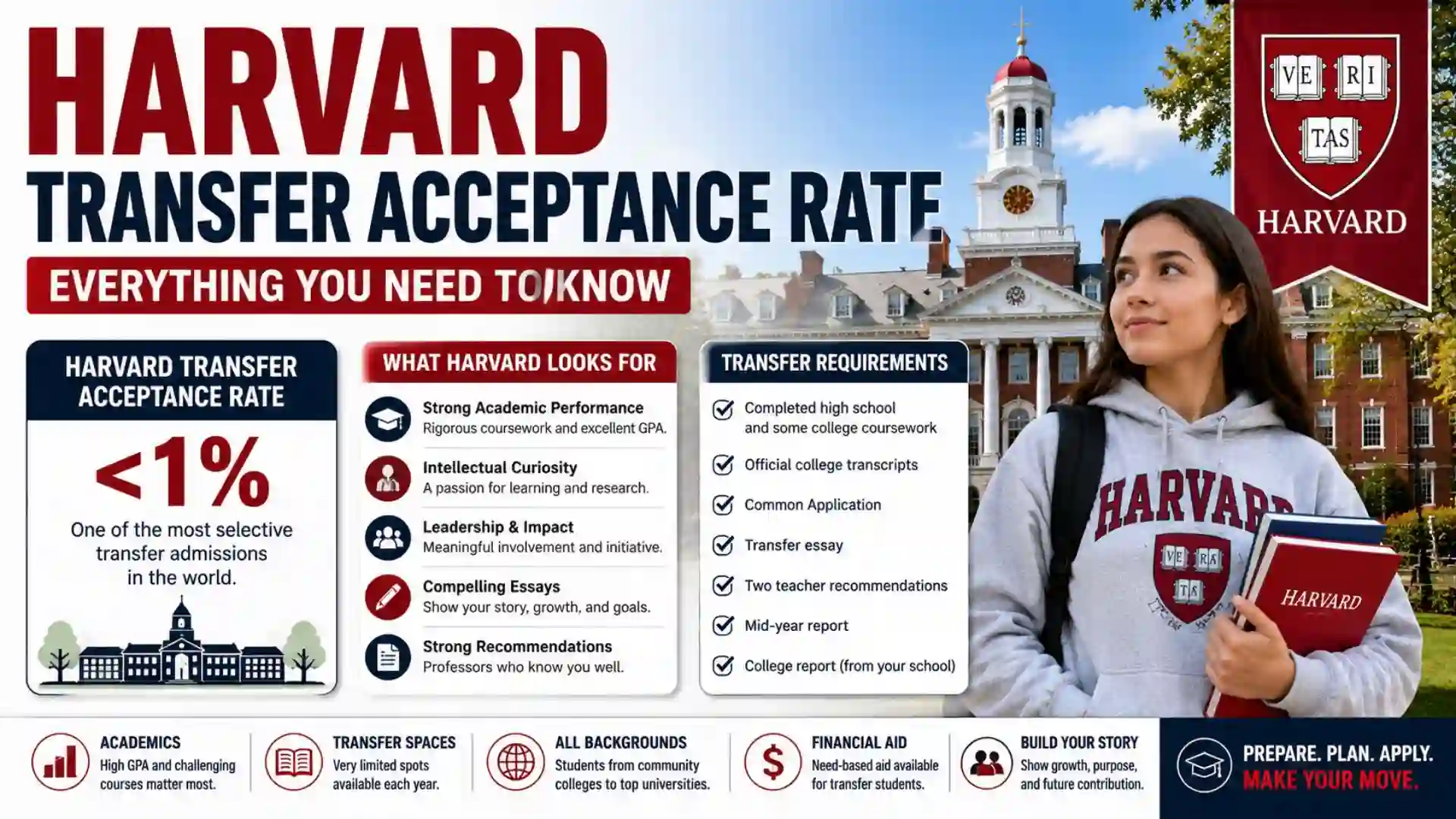
The Harvard transfer acceptance rate is extremely low. In many admission cycles, the transfer acceptance rate has been below 1% or only slightly higher.
This means that out of thousands of transfer applicants, only a very small number receive admission offers.
Harvard transfer admissions are highly selective because:
- Very limited transfer spaces are available
- Many applicants already have exceptional academic records
- Harvard prioritizes freshman admissions
- Transfer students must demonstrate outstanding potential
Students should understand that transferring to Harvard is significantly more competitive than transferring to many other universities.
Why Is the Harvard Transfer Acceptance Rate So Low?
Several factors contribute to the extremely low Harvard transfer acceptance rate.
Limited Space Availability
Harvard admits most students as first-year applicants. Since relatively few enrolled students leave Harvard, there are very limited openings for transfer students.
Some years may only have space for a small transfer class.
Highly Qualified Applicants
Transfer applicants often include students from:
- Top universities
- Honors programs
- Community colleges with exceptional performance
- International institutions
Many applicants already have outstanding GPAs, leadership achievements, research experience, and compelling personal stories.
Holistic Admissions Process
Harvard evaluates transfer applicants holistically rather than focusing solely on GPA or test scores.
Admissions officers consider:
- Academic rigor
- College performance
- Extracurricular involvement
- Essays
- Recommendations
- Personal background
- Reasons for transferring
This makes admissions highly competitive and unpredictable.
Important Harvard Transfer Information
| Category | Information |
|---|---|
| University Name | Harvard University |
| Admission Type | Transfer Admissions |
| Typical Transfer Acceptance Rate | Extremely low, often below 1% |
| Transfer Application Platform | Common Application |
| Recommended GPA | Usually 3.8 or higher |
| Required College Coursework | Yes |
| Standardized Tests | May vary by cycle |
| Financial Aid | Need-based aid available |
| International Transfers Accepted | Yes |
| Transfer Credits | Evaluated individually |
Important Harvard Transfer Resources
| Resource | Purpose |
|---|---|
| Harvard Admissions Website | Official transfer admissions details |
| Harvard Transfer Application Portal | Submit transfer application |
| Harvard Financial Aid Office | Financial aid and scholarships |
| Harvard Academics | Explore majors and programs |
| Harvard Student Life | Learn about campus life |
| Common Application | Main transfer application platform |
| College Transcript Services | Submit official transcripts |
| Recommendation Letter System | Upload academic recommendations |
Who Can Apply as a Transfer Student?
Harvard accepts applications from students who have completed college coursework after high school graduation.
Eligible applicants may include:
- Community college students
- Students at four-year universities
- International college students
- Military veterans with academic experience
Transfer applicants typically must demonstrate strong academic achievement at the college level.
GPA Expectations for Harvard Transfer Applicants
One of the most common questions students ask about the Harvard transfer acceptance rate is what GPA they need.
While Harvard does not publish an official minimum GPA requirement, successful transfer applicants usually have exceptionally high college GPAs.
Competitive applicants often have:
| GPA Type | Competitive Range |
|---|---|
| College GPA | 3.8–4.0 |
| Community College GPA | 3.9+ often preferred |
| High School GPA | Strong academic history still helpful |
However, GPA alone is never enough.
Harvard evaluates the difficulty of your coursework, academic improvement, and overall intellectual engagement.
Does Harvard Accept Community College Transfers?
Yes. Harvard does accept community college transfer students.
In fact, Harvard has publicly emphasized interest in students from diverse educational backgrounds, including community colleges.
Successful community college applicants often demonstrate:
- Exceptional academic performance
- Leadership experience
- Personal resilience
- Intellectual curiosity
- Strong transfer motivation
Community college students should not assume they have no chance simply because they did not initially attend a four-year university.
Why Do Students Want to Transfer to Harvard?
Students pursue transfer admission for many different reasons.
Common motivations include:
- Access to world-class academics
- Better research opportunities
- Stronger networking
- Career advancement
- Financial aid opportunities
- Academic fit
- Prestige and reputation
Harvard’s global recognition makes it appealing to ambitious students seeking exceptional educational and professional opportunities.
Academic Rigor Matters a Lot
Harvard values students who challenge themselves academically.
Transfer applicants should ideally complete demanding college coursework, including:
- Advanced mathematics
- Laboratory sciences
- Writing-intensive classes
- Honors seminars
- Research-based courses
Admissions officers want evidence that students can thrive in Harvard’s rigorous academic environment.
Transfer Essays Are Extremely Important
Transfer essays play a major role in admissions decisions.
Harvard wants to understand:
- Why you want to transfer
- Why Harvard specifically fits your goals
- What you have learned in college
- How you have grown academically and personally
- What you will contribute to Harvard
Strong essays are authentic, reflective, and deeply personal.
Generic essays explaining only prestige or rankings are far less effective.
Recommendation Letters Matter
Harvard transfer applicants usually need academic recommendations from college professors.
Strong recommendation letters should highlight:
- Intellectual ability
- Academic curiosity
- Leadership
- Classroom contributions
- Research skills
- Character and maturity
Recommendations from professors who know you well are far more valuable than generic endorsements.
Extracurricular Activities and Leadership
Transfer applicants should also demonstrate meaningful involvement outside academics.
Strong extracurricular examples include:
- Research projects
- Leadership positions
- Community service
- Entrepreneurship
- Student government
- Volunteer initiatives
- Artistic achievements
Harvard seeks students who contribute meaningfully to their communities.
Harvard Wants a Clear Reason for Transfer
One of the most important aspects of a transfer application is explaining why you want to leave your current institution.
Weak reasons include:
- Wanting more prestige
- Disliking campus social life
- Wanting a famous degree
Stronger reasons may include:
- Academic opportunities unavailable at your current school
- Specific research interests
- Unique programs at Harvard
- Intellectual goals aligned with Harvard resources
Your transfer narrative should feel thoughtful and genuine.
Standardized Test Scores for Transfer Applicants
Testing policies can vary depending on the admissions cycle.
Some transfer applicants may still submit:
- SAT scores
- ACT scores
- English proficiency exams for international students
Strong scores can reinforce academic readiness, especially for highly competitive applicants.
Financial Aid for Transfer Students
Harvard offers generous need-based financial aid for transfer students.
Many students worry that transferring to Harvard may be financially impossible, but Harvard’s financial aid policies can make attendance affordable for qualifying families.
Financial aid may include:
- Scholarships
- Grants
- Reduced student debt
- Work-study opportunities
Harvard evaluates financial need rather than offering merit scholarships.
Housing and Student Life for Transfers
Transfer students at Harvard become part of the broader undergraduate community.
Students may have access to:
- Residential housing
- Student organizations
- Academic advising
- Campus activities
- Research opportunities
Although adjusting socially can sometimes be challenging, many transfer students successfully integrate into campus life.
International Transfer Applicants
International students can apply as transfer applicants to Harvard.
However, international admissions are highly competitive because of limited spaces and global applicant demand.
International applicants may need to demonstrate:
- Excellent academic performance
- Strong English proficiency
- Leadership and extracurricular impact
- Exceptional essays
Harvard values diversity and attracts students from around the world.
Common Reasons Transfer Applicants Get Rejected
Because the Harvard transfer acceptance rate is extremely low, even strong applicants may face rejection.
Common rejection reasons include:
Weak Transfer Motivation
Admissions officers may not see a compelling reason for transferring.
Average Academic Performance
Applicants need exceptionally strong college records.
Generic Essays
Weak or generic essays reduce competitiveness.
Lack of Leadership or Impact
Harvard values students who contribute beyond academics.
Poor Recommendation Letters
Generic recommendations fail to strengthen the application.
Can You Transfer to Harvard From Any College?
Yes. Harvard transfer applicants come from many different institutions.
Students may transfer from:
- Community colleges
- Public universities
- Liberal arts colleges
- International institutions
- Ivy League universities
Your current college matters less than your performance and overall application strength.
Transfer Credits and Academic Requirements
Not all college credits automatically transfer to Harvard.
Harvard reviews transfer credits individually.
Factors considered include:
- Course rigor
- Academic content
- Institution accreditation
- Program compatibility
Students should understand that transferring may affect graduation timelines.
How to Improve Your Chances of Transfer Admission?
Students hoping to overcome the low Harvard transfer acceptance rate should focus on building the strongest possible application.
Maintain an Exceptional GPA
Academic excellence is essential.
Take Challenging Courses
Rigorous coursework demonstrates readiness for Harvard academics.
Build Strong Relationships With Professors
This helps secure detailed recommendation letters.
Pursue Meaningful Leadership
Leadership and impact strengthen your application.
Write Authentic Essays
Explain your transfer reasons clearly and thoughtfully.
Demonstrate Intellectual Curiosity
Research, projects, and academic engagement matter greatly.
Mental Health and Transfer Admissions Pressure
Transfer admissions can become emotionally exhausting because of the extremely competitive nature of the process.
Students should remember:
- Rejection does not define intelligence
- Harvard is not the only path to success
- Many excellent universities exist
- Personal growth matters more than prestige
Maintaining a healthy perspective is important during the admissions process.
Alternative Universities With Strong Transfer Programs
Students should also consider other universities with excellent transfer opportunities.
Examples include:
- Stanford University
- Yale University
- Columbia University
- University of Chicago
- Northwestern University
- Brown University
- Cornell University
Applying broadly increases opportunities and reduces pressure.
Myths About the Harvard Transfer Acceptance Rate
Many misconceptions exist about Harvard transfer admissions.
Myth: Only Ivy League Students Can Transfer
False. Community college students and public university students can also gain admission.
Myth: GPA Is the Only Important Factor
False. Harvard uses holistic review.
Myth: Transfer Students Cannot Succeed Socially
False. Many transfer students successfully integrate into Harvard life.
Myth: Perfect Grades Guarantee Admission
False. Even exceptional applicants may be rejected.
FAQ about Harvard Transfer Acceptance Rate
What is the Harvard transfer acceptance rate?
The Harvard transfer acceptance rate is extremely low and is often below 1% in many admissions cycles.
Is it harder to transfer to Harvard than apply as a freshman?
Yes. Transfer admissions are usually even more competitive because fewer spots are available.
What GPA do I need to transfer to Harvard?
Competitive applicants often have college GPAs between 3.8 and 4.0.
Does Harvard accept community college transfer students?
Yes. Harvard accepts qualified community college applicants.
Are transfer essays important?
Yes. Essays are one of the most important parts of the transfer application.
Can international students transfer to Harvard?
Yes. International students can apply, though admissions are highly competitive.
Does Harvard offer financial aid for transfer students?
Yes. Harvard provides need-based financial aid for eligible transfer students.
Can I transfer to Harvard after one year of college?
Some students apply after completing one year of college coursework, depending on eligibility requirements.
Conclusion
The Harvard transfer acceptance rate is among the lowest and most competitive in higher education. Every year, thousands of highly accomplished college students apply for only a very limited number of available transfer spots.
Although the odds are extremely challenging, transfer admission is still possible for students who demonstrate exceptional academic performance, strong leadership, intellectual curiosity, meaningful extracurricular involvement, and a compelling reason for transferring.
Students should understand that Harvard evaluates transfer applicants holistically. GPA alone is not enough. Essays, recommendations, academic rigor, personal growth, and overall impact all play critical roles in admissions decisions.
For students considering transfer applications, the best strategy is to focus on academic excellence, authentic storytelling, leadership development, and long-term intellectual growth rather than obsessing only over acceptance statistics.
Even though the Harvard transfer acceptance rate is extremely low, determined and highly qualified students can still build competitive applications and pursue their educational goals with confidence.