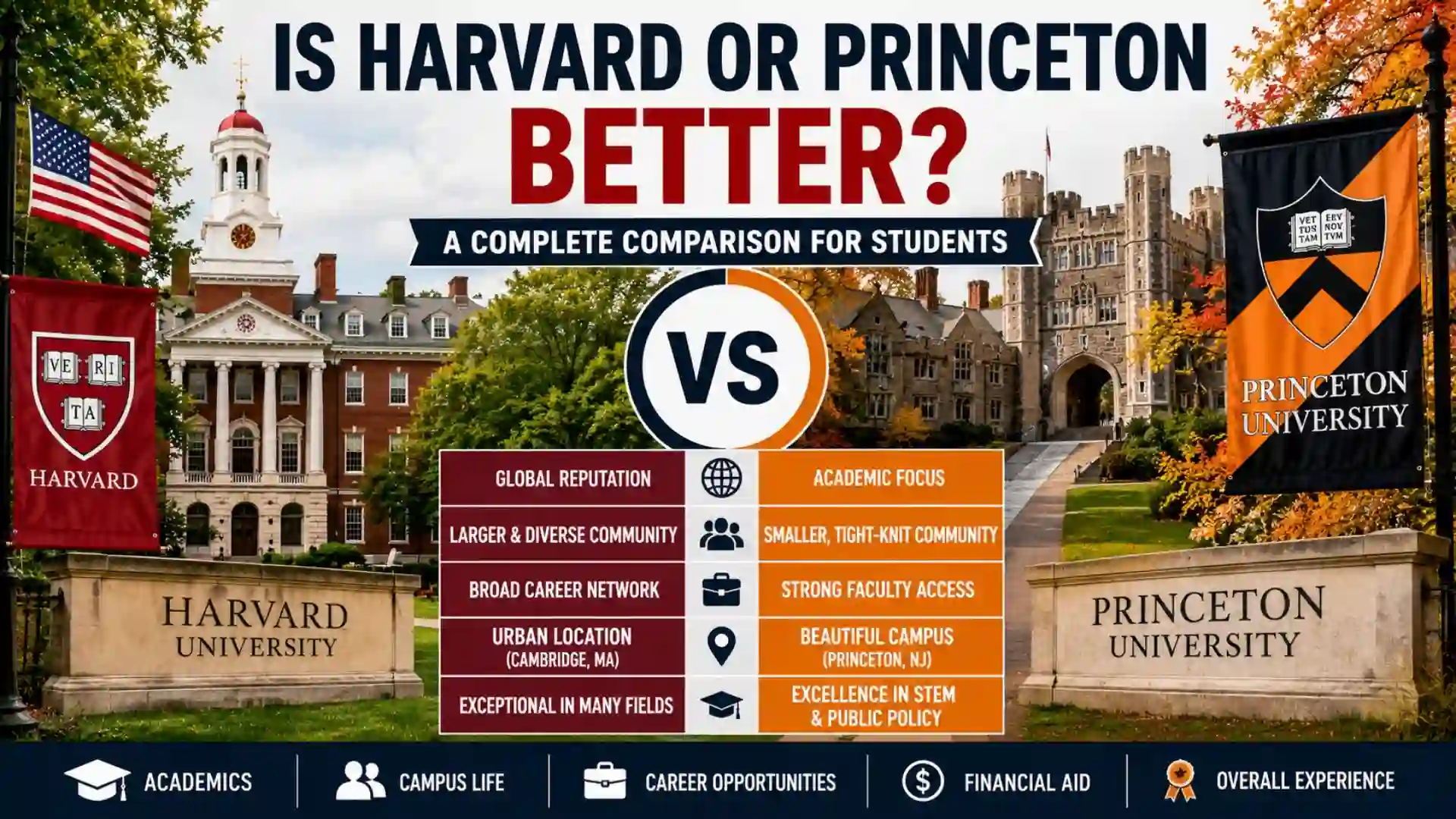
Is Harvard or Princeton Better? Choosing between Harvard University and Princeton University is one of the toughest decisions many students face during the college admissions process. Both universities are world-famous Ivy League institutions known for academic excellence, elite faculty, outstanding career opportunities, and influential alumni networks. Because both schools consistently rank among the top universities globally, students often ask the question: is Harvard or Princeton better?
The truth is that there is no universal answer. The better university depends on your academic goals, personality, career ambitions, learning style, and preferred campus experience. Harvard and Princeton are both exceptional institutions, but they differ in important ways, including campus culture, class sizes, academic focus, social environment, research opportunities, and student life.
Some students may thrive at Harvard because of its global prestige, larger campus environment, and extensive networking opportunities. Others may prefer Princeton because of its smaller undergraduate focus, close-knit community, and strong emphasis on teaching and research mentorship.
In this article, we will compare Harvard and Princeton in detail to help you understand which university may be the better fit for you.
Overview of Harvard and Princeton
Harvard University and Princeton University are both private Ivy League universities located in the northeastern United States.
Harvard University is located in Cambridge, Massachusetts, near Boston. Founded in 1636, it is the oldest university in the United States and one of the most recognized institutions in the world.
Princeton University is located in Princeton, New Jersey. Founded in 1746, Princeton is also one of America’s oldest and most prestigious universities, especially known for its undergraduate education and strong academic community.
Both universities offer exceptional education, but their environments and priorities are slightly different.
Important Harvard and Princeton Information
| Category | Harvard University | Princeton University |
|---|---|---|
| Location | Cambridge, Massachusetts | Princeton, New Jersey |
| Founded | 1636 | 1746 |
| University Type | Private Ivy League | Private Ivy League |
| Undergraduate Enrollment | Larger student population | Smaller undergraduate focus |
| Campus Style | Urban and busy | Traditional and quieter |
| Acceptance Rate | Extremely selective | Extremely selective |
| Known Strengths | Law, business, medicine, politics | Engineering, mathematics, public policy |
| Financial Aid | Need-based aid | Generous need-based aid |
| Student-Faculty Interaction | Strong | Extremely strong |
| Undergraduate Focus | Balanced with graduate programs | Heavy undergraduate emphasis |
Important Harvard and Princeton Resources
| Resource | Purpose |
|---|---|
| Harvard Admissions Website | Undergraduate admissions information |
| Princeton Admissions Website | Undergraduate admissions information |
| Harvard Financial Aid | Scholarship and aid information |
| Princeton Financial Aid | Scholarship and aid information |
| Harvard Academics | Explore majors and programs |
| Princeton Academics | Explore majors and programs |
| Harvard Student Life | Campus and student experience |
| Princeton Student Life | Residential and campus life |
Prestige and Global Reputation
When discussing “is Harvard or Princeton better,” prestige is often the first factor students consider.
Harvard has one of the strongest global reputations of any university in the world. The Harvard name carries enormous recognition internationally, especially in fields like law, medicine, business, government, and finance.
Many world leaders, billionaires, Nobel Prize winners, and influential public figures attended Harvard. The university’s alumni network is massive and powerful.
Princeton also has an outstanding global reputation, though it is often viewed as slightly more academically focused and less commercially visible than Harvard.
Both schools are prestigious, but Harvard generally has greater worldwide brand recognition.
Undergraduate Experience
One of the biggest differences between Harvard and Princeton is the undergraduate experience.
Princeton is heavily focused on undergraduate education. Unlike Harvard, Princeton does not have large professional schools like a medical school, law school, or business school dominating campus life.
This means Princeton often provides:
- Smaller class sizes
- More direct faculty interaction
- Greater undergraduate attention
- Stronger academic mentorship
Many students feel Princeton prioritizes undergraduates more intensely than Harvard.
Harvard, while excellent for undergraduates, also has major graduate and professional schools that influence the overall campus environment.
Students seeking a highly personalized undergraduate experience may prefer Princeton.
Academic Environment
Both universities are academically intense, but their cultures differ.
Harvard’s academic environment is often viewed as ambitious, competitive, and highly diverse. Students pursue many different interests simultaneously, including entrepreneurship, politics, research, athletics, and social activism.
Princeton’s academic environment is often described as intellectual, rigorous, and deeply academic. The university places heavy emphasis on research, critical thinking, and scholarly development.
Princeton students are required to complete senior theses in many programs, which encourages deep academic exploration.
Students who prefer a more academically focused atmosphere may lean toward Princeton.
Campus Culture and Student Life
Campus culture is another important factor when asking, “is Harvard or Princeton better?”
Harvard is located near Boston, giving students access to a major city environment. Students enjoy:
- Museums
- Restaurants
- Internships
- Networking events
- Cultural activities
- Startup opportunities
Harvard’s social scene is diverse and fast-paced.
Princeton offers a quieter and more traditional college-town atmosphere. The campus is beautiful, peaceful, and close-knit.
Princeton students often describe the community as:
- Tight-knit
- Collaborative
- Intellectual
- Residential-focused
Students who enjoy urban environments may prefer Harvard, while those wanting a more classic campus experience may prefer Princeton.
Class Sizes and Faculty Access
Princeton is known for exceptionally strong student-faculty interaction.
Because Princeton has fewer graduate students, undergraduates often receive greater access to professors and research opportunities.
Princeton emphasizes:
- Small seminars
- Close mentorship
- Undergraduate research
- Faculty engagement
Harvard also offers strong faculty access, but the larger student body and extensive graduate programs can make the experience feel less personal in some cases.
Students who value close relationships with professors may prefer Princeton.
Research Opportunities
Both universities provide extraordinary research opportunities.
Harvard offers access to:
- World-class medical research
- Government policy research
- Business innovation
- Scientific laboratories
- Global academic partnerships
Its location near Boston also creates additional research and internship possibilities.
Princeton excels in:
- Mathematics
- Physics
- Engineering
- Public policy
- Theoretical sciences
Because Princeton focuses heavily on undergraduates, students may receive earlier access to meaningful research experiences.
Financial Aid and Affordability
Both universities offer generous need-based financial aid.
Harvard and Princeton are committed to making education accessible regardless of family income.
Both schools provide:
- Need-based scholarships
- Reduced student debt
- Strong financial support packages
Princeton is particularly well known for its strong financial aid policies and undergraduate support.
For many students, cost differences between the two universities may be minimal after financial aid.
Housing and Residential Life
Princeton has a highly residential campus culture.
Most students remain closely connected to campus housing and residential colleges throughout their undergraduate years.
The university emphasizes community-building and student interaction.
Harvard also has a strong residential house system, especially after freshman year. Harvard Houses create smaller communities within the larger university.
Both universities provide excellent residential experiences, though Princeton’s smaller environment may feel more intimate.
Career Opportunities and Networking
Harvard’s global network is one of its greatest strengths.
Harvard alumni connections can provide advantages in:
- Finance
- Politics
- Law
- Consulting
- Entrepreneurship
- Media
Harvard’s reputation often opens doors worldwide.
Princeton also has an influential alumni network, particularly in academia, public policy, engineering, and finance.
Both universities offer exceptional career opportunities, though Harvard’s broader international recognition may provide additional networking advantages.
Social Environment
Harvard’s larger student body creates a more diverse social atmosphere.
Students can explore:
- Numerous student organizations
- Political groups
- Entrepreneurial communities
- Cultural clubs
- Artistic activities
Princeton’s smaller student population often creates stronger interpersonal connections and a more unified campus culture.
Some students prefer Harvard’s broader opportunities, while others value Princeton’s close-knit environment.
Athletics and Extracurricular Activities
Both universities have strong extracurricular programs.
Harvard offers:
- NCAA Division I athletics
- Extensive student organizations
- Entrepreneurship programs
- Public service opportunities
Princeton also has excellent athletics and extracurriculars, but the environment may feel slightly less intense and more academically centered.
Students interested in balancing academics with broad extracurricular exploration may prefer Harvard.
Which University Is Harder to Get Into?
Both Harvard and Princeton are among the most selective universities in the world.
Admissions at both schools are extremely competitive.
Applicants generally need:
- Excellent grades
- High SAT or ACT scores
- Strong extracurricular involvement
- Leadership experience
- Outstanding essays
- Exceptional recommendation letters
Acceptance rates at both schools are usually below 5%.
Neither university is significantly easier than the other.
Which University Is Better for Specific Majors?
Students often ask which university is better for particular academic fields.
Harvard Is Often Stronger For:
- Law
- Business
- Medicine
- Government
- Economics
- Political science
Princeton Is Often Stronger For:
- Mathematics
- Physics
- Engineering
- Public policy
- Theoretical sciences
However, both universities are exceptional across nearly all disciplines.
Student Personality Fit
Choosing between Harvard and Princeton often comes down to personality fit.
Students who may prefer Harvard often enjoy:
- Large networks
- Fast-paced environments
- Urban settings
- Broad opportunities
- Entrepreneurship and leadership
Students who may prefer Princeton often value:
- Close academic communities
- Small class sizes
- Deep intellectual engagement
- Strong faculty mentorship
- Traditional campus life
The best choice depends on where you feel most comfortable and motivated.
Mental Health and Academic Pressure
Both universities are academically demanding.
Students at Harvard and Princeton often experience significant academic pressure because they are surrounded by extremely talented peers.
However, both schools have expanded mental health resources and wellness programs to support students.
Students should prioritize:
- Personal well-being
- Healthy study habits
- Work-life balance
- Emotional support systems
Prestige alone should never outweigh personal happiness and mental health.
Is Harvard Better Than Princeton for International Students?
Harvard’s global brand recognition may provide stronger international visibility.
Many international students are familiar with Harvard due to its worldwide reputation in media, business, and politics.
Princeton also attracts exceptional international students, especially those interested in highly academic and research-focused environments.
Both universities offer excellent opportunities for international students.
Common Misconceptions About Harvard and Princeton
Many students have unrealistic assumptions about these universities.
Myth: Harvard Is Automatically Better
Harvard is more globally famous, but Princeton may provide a better undergraduate experience for some students.
Myth: Princeton Is Less Prestigious
Princeton is one of the world’s top universities and highly respected academically.
Myth: Prestige Guarantees Happiness
Student fit matters more than rankings alone.
Myth: One School Is Easier Academically
Both universities are academically rigorous.
How to Decide Between Harvard and Princeton?
Students deciding between the two universities should consider:
- Academic interests
- Preferred campus size
- Learning style
- Career goals
- Social environment
- Research opportunities
- Financial aid packages
- Personal comfort
Visiting campuses, speaking with current students, and reflecting honestly on your priorities can help you make the right choice.
FAQ about Is Harvard or Princeton Better?
Is Harvard or Princeton better overall?
Neither university is objectively better overall. The best choice depends on your goals, personality, and academic interests.
Is Harvard more prestigious than Princeton?
Harvard generally has stronger global brand recognition, but Princeton is equally respected academically.
Which university is better for undergraduate students?
Many students believe Princeton offers a stronger undergraduate-focused experience because of its smaller size and faculty access.
Is Princeton easier to get into than Harvard?
No. Both universities are extremely selective with very low acceptance rates.
Which school has better financial aid?
Both universities offer generous need-based financial aid packages.
Is Harvard better for business and law?
Harvard is especially famous for business, law, politics, and medicine.
Is Princeton better for science and engineering?
Princeton is particularly strong in mathematics, physics, engineering, and theoretical sciences.
Which university has better student life?
This depends on personal preference. Harvard offers a larger and more urban environment, while Princeton provides a smaller and more close-knit community.
Conclusion
So, is Harvard or Princeton better?
The answer depends entirely on what you want from your college experience.
Harvard may be the better choice for students seeking a globally recognized brand, expansive networking opportunities, urban energy, and broad professional connections. Its reputation in business, law, medicine, and politics is unmatched in many parts of the world.
Princeton may be the better choice for students who value close faculty relationships, smaller class sizes, deep academic engagement, and a highly undergraduate-focused environment. Its emphasis on teaching, mentorship, and intellectual development creates a uniquely personal academic experience.
Both universities provide world-class education, extraordinary opportunities, and life-changing experiences. There is no wrong choice between Harvard and Princeton.
Ultimately, the best university is the one where you will feel challenged, supported, inspired, and happy. Students should focus less on rankings and more on finding the environment that best matches their goals, personality, and vision for the future.