
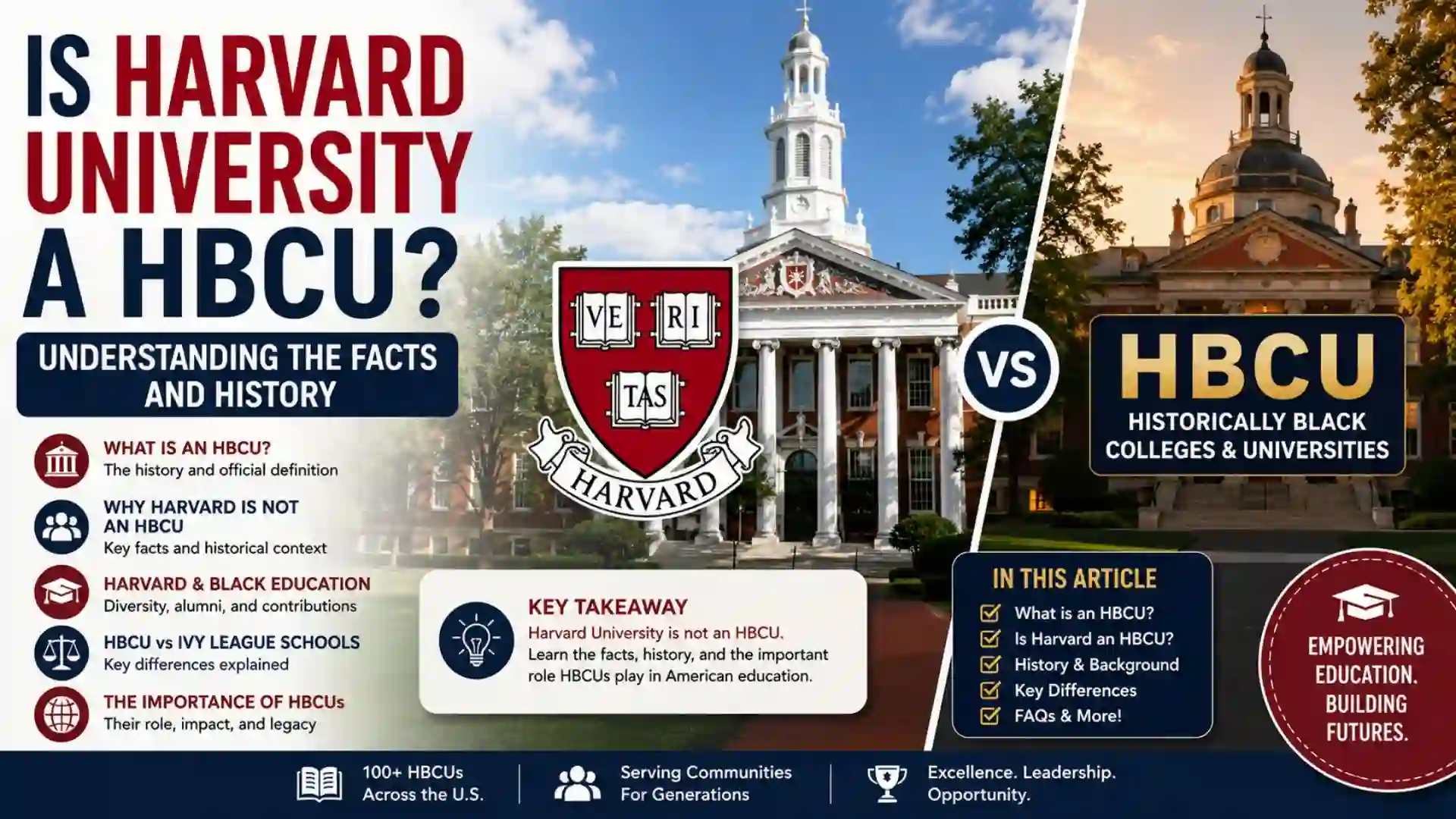
Is Harvard University a HBCU? Many students and education enthusiasts often ask the question: is Harvard University a HBCU? Because Harvard University is one of the most famous educational institutions in the world and has a diverse student population, some people assume it may qualify as a Historically Black College or University (HBCU). However, the answer is more complex and requires understanding the history and definition of HBCUs.
The simple answer is that Harvard University is not an HBCU. Although Harvard has educated many influential Black leaders, scholars, activists, and professionals, it does not meet the official historical criteria required to be classified as a Historically Black College or University.
In this detailed article, you will learn what an HBCU is, why Harvard is not considered one, the history behind HBCUs, Harvard’s relationship with Black education, differences between Harvard and HBCUs, and answers to frequently asked questions related to the topic.
What Is an HBCU?
To understand is Harvard University a HBCU, you first need to understand the meaning of HBCU.
Definition of HBCU
HBCU stands for Historically Black College or University.
These institutions were established primarily to educate African American students during periods when racial segregation and discrimination prevented Black students from attending many predominantly white colleges and universities.
Official Definition
In the United States, HBCUs are institutions of higher education established before 1964 with the principal mission of educating Black Americans.
These institutions were created because African Americans historically faced limited educational opportunities.
Is Harvard University a HBCU?
Direct Answer
No, Harvard University is not an HBCU.
Harvard University does not qualify as a Historically Black College or University because:
- It was not founded specifically to educate Black students
- It was established long before the HBCU designation existed
- Its primary historical mission was not focused on Black education
Although Harvard enrolls Black students and supports diversity initiatives today, it is officially categorized as a predominantly white institution (PWI), not an HBCU.
What Type of Institution Is Harvard University?
Harvard University is classified as:
| Category | Classification |
|---|---|
| Institution Type | Private Ivy League University |
| Founded | 1636 |
| Location | Cambridge, Massachusetts |
| School Type | Predominantly White Institution (PWI) |
| Research Status | Research University |
| Athletic Conference | Ivy League |
Harvard is the oldest university in the United States and one of the world’s leading research institutions.
Understanding the History of HBCUs
The history of HBCUs is central to understanding why the answer to is Harvard University a HBCU is no.
Why HBCUs Were Created?
Before the Civil Rights Movement, many colleges either:
- Denied admission to Black students
- Limited Black enrollment
- Enforced segregation policies
As a result, Black communities and religious organizations established colleges specifically to provide educational opportunities for African Americans.
Early HBCUs
Some of the earliest HBCUs include:
| Institution | Founded |
|---|---|
| Cheyney University | 1837 |
| Lincoln University | 1854 |
| Howard University | 1867 |
| Morehouse College | 1867 |
| Fisk University | 1866 |
These institutions played a major role in advancing African American education and leadership.
Why Harvard Is Not Considered an HBCU?
Even though Harvard has educated many Black students and leaders, it does not meet the defining characteristics of an HBCU.
Harvard’s Original Mission
Harvard was originally established to educate clergy and elite members of colonial society.
Its founding mission did not specifically focus on educating African Americans.
Historical Admissions
For much of American history, elite institutions like Harvard were dominated by white students.
Although Harvard eventually became more diverse, that change came later and does not alter its institutional classification.
Official Recognition
The U.S. Department of Education officially recognizes HBCUs based on historical criteria. Harvard is not included on the HBCU list.
What Is a Predominantly White Institution (PWI)?
Since Harvard is not an HBCU, it is usually categorized as a PWI.
Definition of PWI
A Predominantly White Institution is a college or university where white students historically make up the majority of enrollment.
Many Ivy League schools fall into this category.
Characteristics of PWIs
| Feature | Description |
|---|---|
| Majority Demographic | Historically white student population |
| Admissions | Open to all qualified students |
| Diversity | Varies by institution |
| Historical Background | Often founded before integration |
Harvard fits this classification more accurately than HBCU.
Harvard’s Relationship With Black Education
Although Harvard is not an HBCU, it has played an important role in Black education and leadership.
Black Students at Harvard
Over time, Harvard has educated many influential Black figures in:
- Politics
- Civil rights
- Law
- Science
- Literature
- Business
Famous Black Harvard Alumni
Some notable Black alumni include:
| Name | Profession |
|---|---|
| Barack Obama | Former U.S. President |
| W.E.B. Du Bois | Sociologist and activist |
| Thurgood Marshall | Supreme Court Justice |
| Cornel West | Philosopher |
| Ketanji Brown Jackson | Supreme Court Justice |
These individuals contributed significantly to American society.
Harvard and Diversity Initiatives
Modern Harvard promotes diversity and inclusion through multiple programs.
Examples Include
- Scholarships
- Minority student organizations
- Diversity recruitment
- Cultural centers
- Research initiatives
However, diversity efforts alone do not make an institution an HBCU.
What Makes an HBCU Unique?
Understanding HBCU culture helps clarify why Harvard differs from these institutions.
Community and Cultural Identity
HBCUs often emphasize:
- Black history
- African American culture
- Community empowerment
- Representation
- Social justice
Historical Importance
HBCUs were essential during segregation because they provided educational access when many institutions excluded Black students.
Differences Between Harvard and HBCUs
Institutional Mission
| Feature | Harvard University | HBCUs |
|—|—|
| Original Purpose | Elite higher education | Educating Black Americans |
| Historical Role | Ivy League institution | Civil rights and Black advancement |
| Student Demographics | Diverse PWI | Historically Black-focused |
| Cultural Mission | Broad academic excellence | Black educational empowerment |
Are HBCUs Better Than Ivy League Schools?
This question often appears alongside searches for is Harvard University a HBCU.
The answer depends on personal goals, academic interests, financial considerations, and campus culture preferences.
Strengths of HBCUs
- Strong community support
- Cultural connection
- Leadership development
- Historically significant traditions
Strengths of Harvard
- Global prestige
- Extensive research funding
- International networking
- Broad academic resources
Both types of institutions provide valuable educational opportunities.
Can Non-Black Students Attend HBCUs?
Yes.
HBCUs are open to students of all racial and ethnic backgrounds.
Although they were founded to serve Black students, modern HBCUs welcome diversity.
Similarly, Harvard welcomes students from all backgrounds even though it is not an HBCU.
Why People Confuse Harvard With an HBCU?
There are several reasons why people ask is Harvard University a HBCU.
Harvard’s Diverse Student Population
Harvard enrolls students from many racial and ethnic backgrounds.
Famous Black Alumni
Many well-known Black leaders attended Harvard.
Strong Black Student Organizations
Harvard has active Black cultural and academic organizations.
Public Discussions About Race
Harvard frequently participates in national discussions about diversity and racial equity.
Despite these factors, institutional classification remains unchanged.
Harvard and African American Studies
Harvard has strong academic programs focused on Black history and culture.
Popular Academic Areas
- African American Studies
- Sociology
- Race and Ethnicity Studies
- Civil Rights History
These programs contribute to scholarship about Black experiences worldwide.
The Importance of HBCUs Today
HBCUs continue to play an essential role in American higher education.
Contributions of HBCUs
| Area | Contribution |
|---|---|
| Education | Increased college access |
| Leadership | Produced major Black leaders |
| STEM Fields | Graduated many Black scientists and engineers |
| Social Mobility | Supported economic advancement |
| Cultural Preservation | Preserved African American heritage |
HBCUs remain highly respected institutions.
How Many HBCUs Exist in the United States?
There are more than 100 recognized HBCUs in the United States.
These institutions vary in:
- Size
- Academic focus
- Religious affiliation
- Public or private status
They are located mainly in the Southern United States but exist in other regions as well.
Ivy League Schools and HBCUs
Harvard belongs to the Ivy League, a group of elite Northeastern universities.
Ivy League Schools
| School | Location |
|---|---|
| Harvard University | Massachusetts |
| Yale University | Connecticut |
| Princeton University | New Jersey |
| Columbia University | New York |
| Brown University | Rhode Island |
| Dartmouth College | New Hampshire |
| University of Pennsylvania | Pennsylvania |
| Cornell University | New York |
None of the Ivy League schools are HBCUs.
Harvard’s Historical Challenges With Diversity
Like many old institutions, Harvard has faced criticism regarding historical inequality.
Areas of Discussion
- Admissions access
- Representation
- Campus climate
- Historical discrimination
Modern diversity efforts attempt to address these concerns.
The Role of HBCUs in Civil Rights
HBCUs played a major role during the Civil Rights Movement.
Students and graduates from HBCUs often became leaders in:
- Activism
- Voting rights campaigns
- Education reform
- Legal battles for equality
This historical mission distinguishes HBCUs from institutions like Harvard.
Student Experience at Harvard vs HBCUs
Harvard Experience
Students often describe Harvard as:
- Competitive
- Prestigious
- Research-focused
- Internationally connected
HBCU Experience
Students at HBCUs often describe:
- Strong cultural support
- Family-like community
- Identity affirmation
- Leadership development
Both experiences offer unique advantages.
Important Information
| Topic | Details |
|---|---|
| Is Harvard an HBCU? | No |
| Harvard Classification | Predominantly White Institution |
| Harvard Founded | 1636 |
| HBCU Definition | Historically Black College or University |
| Purpose of HBCUs | Educating Black Americans during segregation |
| Harvard Location | Cambridge, Massachusetts |
| Ivy League Status | Yes |
| Number of HBCUs in U.S. | More than 100 |
| Harvard Diversity Programs | Yes |
| Official HBCU Recognition | Harvard is not recognized as an HBCU |
Common Myths About Harvard and HBCUs
Myth 1: Diverse Schools Are Automatically HBCUs
Diversity alone does not determine HBCU status.
Myth 2: HBCUs Only Admit Black Students
HBCUs admit students of all backgrounds.
Myth 3: Harvard Was Founded for Black Education
This is historically inaccurate.
Myth 4: Ivy League Schools Are HBCUs
No Ivy League institution qualifies as an HBCU.
Why HBCUs Remain Important?
Even today, HBCUs continue to:
- Produce Black professionals
- Promote representation
- Support underserved communities
- Preserve African American culture
- Create leadership opportunities
Their historical and social significance remains powerful.
FAQ about Is Harvard University a HBCU?
Is Harvard University officially an HBCU?
No, Harvard University is not officially recognized as an HBCU.
Why is Harvard not considered an HBCU?
Because it was not founded primarily to educate Black students and does not meet official HBCU criteria.
What type of school is Harvard?
Harvard is a private Ivy League research university and a predominantly white institution.
Are there Black students at Harvard?
Yes, Harvard has a diverse student population that includes Black students from many backgrounds.
Can white students attend HBCUs?
Yes, HBCUs are open to students of all races and ethnicities.
Is Howard University an HBCU?
Yes, Howard University is one of the most famous HBCUs in the United States.
Does Harvard support diversity programs?
Yes, Harvard has multiple diversity and inclusion initiatives.
What is the difference between Harvard and an HBCU?
HBCUs were founded specifically to educate Black Americans, while Harvard was not.
Are Ivy League schools HBCUs?
No, none of the Ivy League schools are classified as HBCUs.
Why are HBCUs historically important?
They provided educational opportunities to Black Americans during segregation and helped develop generations of leaders.
Conclusion
If you have been wondering is Harvard University a HBCU, the answer is clearly no. Harvard University is not a Historically Black College or University because it was not founded with the primary mission of educating Black Americans during segregation.
Instead, Harvard is classified as a private Ivy League university and a predominantly white institution. Nevertheless, Harvard has educated many influential Black leaders and continues to support diversity, inclusion, and African American studies programs.
HBCUs hold a unique and essential place in American educational history. Their mission, cultural significance, and contributions to Black advancement distinguish them from institutions like Harvard. Both Harvard and HBCUs play important roles in higher education, but they were founded for very different historical purposes.
Understanding these distinctions helps students, parents, and readers better appreciate the rich diversity and history of American colleges and universities.