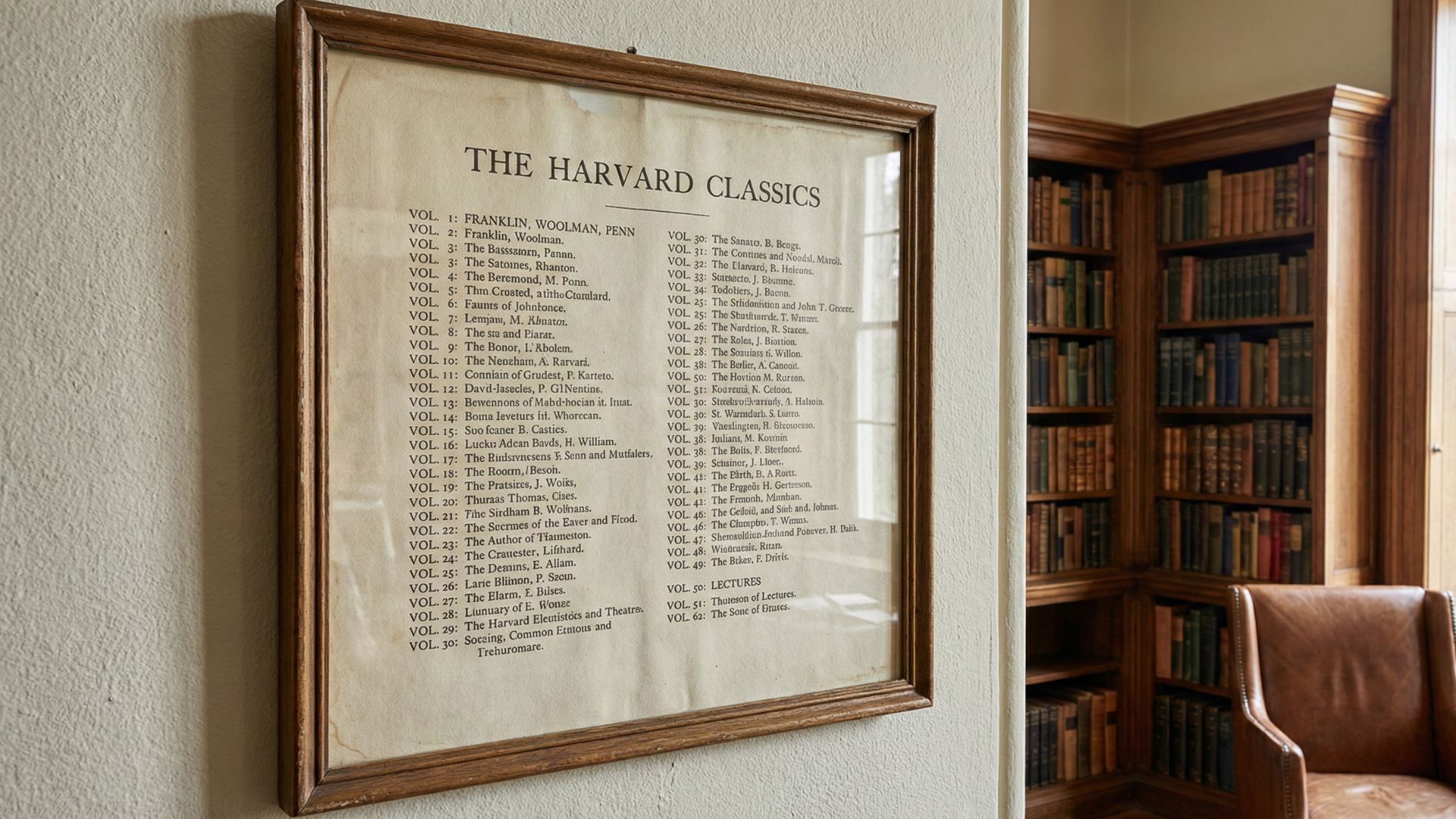
List of the Harvard Classics: The Harvard Classics, also known as Dr. Eliot’s Five-Foot Shelf, is one of the most influential and ambitious literary collections ever assembled. Compiled in the early twentieth century by Dr. Charles W. Eliot, then President of Harvard University, this remarkable set of books was created with a single, transformative idea in mind: that a liberal education could be acquired by reading for just fifteen minutes a day. Eliot believed that within a carefully chosen set of works, a reader could gain a broad intellectual foundation covering literature, philosophy, science, politics, religion, and human thought.
The Harvard Classics collection, first published in 1909, contains fifty-one volumes, each curated to convey timeless wisdom, global cultural heritage, and the best of human expression. Over the years, the collection has remained a symbol of intellectual enrichment and accessible self-education. Students, researchers, avid readers, and lifelong learners continue to rely on the Harvard Classics to deepen their understanding of world literature and the humanities.
This comprehensive article provides a detailed overview of the Harvard Classics collection, the background of its creation, the complete list of its volumes, and the significance of each section. It also includes a table of important links and resources related to the Harvard Classics, along with FAQs and a well-structured conclusion.
Background of the Harvard Classics
Dr. Charles W. Eliot’s Vision
During a public lecture, Dr. Eliot famously declared that a five-foot shelf of books could provide a proper liberal education. This vision inspired P. F. Collier & Son to commission Eliot to curate a comprehensive anthology of the most important works in Western and global literature.
Eliot’s philosophy rested on the idea that education should not be limited to formal institutions. Instead, anyone with dedication and curiosity could cultivate knowledge independently. The Harvard Classics were designed to democratize learning by offering a structured, high-quality reading list that captured essential ideas from diverse fields.
Publication History
The Harvard Classics were first published in 1909–1910. The expanded Harvard Classics Shelf of Fiction was later added. The collection gained popularity worldwide, becoming a staple in homes, libraries, and educational institutions.
The books cover subjects including:
- Poetry
- Drama
- Philosophy
- Essays
- Science
- Travel and exploration
- Political theory
- Religion
- Autobiography
The volumes were chosen for their intellectual value, accessibility, and relevance to a complete self-guided education.
Complete List of the Harvard Classics
Below is the full list of the original 51 volumes of the Harvard Classics. Each volume contains curated excerpts or complete works from prominent authors, thinkers, or historical figures.
Volume 1: Franklin, Woolman, Penn
Autobiographies and reflections that explore personal growth, morality, religious thought, and civic responsibility.
Volume 2: Plato, Epictetus, Marcus Aurelius
Foundational texts of classical philosophy, covering ethics, virtue, justice, and stoicism.
Volume 3: Essays by Bacon, Milton, and Thomas Browne
Masterpieces of English prose exploring science, religion, reason, and politics.
Volume 4: John Milton – Complete Poems
Includes Paradise Lost, Paradise Regained, and selected shorter poems.
Volume 5: R. W. Emerson – Essays
A collection of Emerson’s greatest essays covering individuality, nature, transcendentalism, and self-reliance.
Volume 6: Poetry of the English Renaissance
Works by Spenser, Shakespeare, and Ben Jonson.
Volume 7: Robert Burns – Poems and Songs
A comprehensive selection of Burns’s works reflecting Scottish culture and lyrical poetry.
Volume 8: Nine Greek Dramas
Includes works by Aeschylus, Sophocles, Euripides, and Aristophanes.
Volume 9: Cicero and Pliny
Selections covering ethics, political speeches, and natural history.
Volume 10: The Wealth of Nations – Adam Smith
Influential economic philosophy defining modern capitalism.
Volume 11: The Origin of Species – Charles Darwin
Groundbreaking scientific text on evolution by natural selection.
Volume 12: Plutarch’s Lives
Biographies of Greek and Roman leaders, highlighting moral lessons in leadership.
Volume 13: Aeneid – Virgil
Epic poem exploring duty, destiny, and the founding myths of Rome.
Volume 14: Don Quixote – Cervantes (Selections)
Literary satire blending humor, philosophy, and storytelling.
Volume 15: Pilgrim’s Progress – John Bunyan
A religious allegory that remains a classic in Christian literature.
Volume 16: Arabian Nights (Selected Stories)
Timeless tales of imagination, adventure, and moral reflection.
Volume 17: Modern English Drama
Includes plays from the eighteenth and nineteenth centuries.
Volume 18: Modern English Essays
A selection of essays covering topics such as society, literature, and human behavior.
Volume 19: Elizabethan Drama
Additional dramatic works from the English Renaissance.
Volume 20: Divine Comedy – Dante
Inferno, Purgatory, and Paradise, translated and annotated.
Volume 21: Izaak Walton – Lives
Biographies of Donne, Wotton, Hooker, Herbert, and Sanderson.
Volume 22: The Apology, Phaedo, and Crito – Plato
Fundamental philosophical dialogues exploring ethics and immortality.
Volume 23: Two Years Before the Mast – Richard Henry Dana
A memoir describing sea life and maritime struggles.
Volume 24: On the Sublime, French Revolution, etc.
Includes writings by Burke, Addison, and others on aesthetics and political philosophy.
Volume 25: Autobiography of Cellini
A Renaissance artist’s vivid account of art, conflict, and creativity.
Volume 26: Continental Drama
Includes significant plays from European literature.
Volume 27: English Essays
Essays by Newton, Hume, and Locke among others.
Volume 28: Essays on Education
Includes Rousseau, Pestalozzi, and modern educational theories.
Volume 29: Voyage of the Beagle – Charles Darwin
Darwin’s observations during his world voyage.
Volume 30: Scientific Papers
Includes Faraday, Pasteur, Helmholtz, and others.
Volume 31: The Poetry of Europe
Selections from European poets.
Volume 32: Literary and Philosophical Essays
Works by Montaigne, Schiller, and others.
Volume 33: Voyages and Travels
Accounts of exploration from ancient and modern times.
Volume 34: French and English Philosophers
Includes writings from Voltaire, Rousseau, and Hobbes.
Volume 35: Chronicle and Romance
Medieval historical writings.
Volume 36: Machiavelli, More, and Luther
Political and religious texts that shaped Europe.
Volume 37: English Poetry (Chaucer to Gray)
A major anthology of English verse.
Volume 38: English Poetry (Collins to Fitzgerald)
Includes Romantic and Victorian poets.
Volume 39: Famous Prefaces
Critical introductions from historic editions of classic works.
Volume 40: English Poetry (Tennyson to Whitman)
Includes modern poets and the evolution of poetic style.
Volume 41: American Historical Documents
Documents of U.S. political and cultural significance.
Volume 42: English Prose
A compilation of prose from various eras, focusing on literary development.
Volume 43: American Prose and Poetry
Important works from American writers.
Volume 44: Sacred Writings (Confucian and Buddhist)
Ancient texts foundational to Eastern religions.
Volume 45: Sacred Writings (Hebrew, Christian, and Islamic)
Selections from scriptures and religious texts.
Volume 46: Greek and Roman Philosophy
Includes works by Aristotle, Marcus Aurelius, and others.
Volume 47: Epics and Sagas
World epics including Beowulf and Norse sagas.
Volume 48: Travel, History, and Memoirs
Collections describing global cultures and historic journeys.
Volume 49: Epic and Saga (Continued)
Additional ancient and medieval texts.
Volume 50: Introduction, Reader’s Guide, Index
A detailed guide for readers who wish to explore the collection systematically.
Volume 51: Harvard Classics Lectures and Notes
Scholarly commentary and study tools.
Importance of the Harvard Classics
The Harvard Classics are widely regarded as one of the most comprehensive educational collections in the world. Their significance lies in several key areas:
1. Foundation of Western Thought
The volumes cover major literary, philosophical, and political works that shaped Western civilization.
2. Accessible Education
Eliot’s vision emphasized that great literature should be accessible to everyone regardless of formal education.
3. Holistic Knowledge
The selection spans:
- Science
- Philosophy
- Literature
- Religion
- Art
- History
- Education
4. Structured Learning Approach
The set allows readers to engage with the materials chronologically, thematically, or through Eliot’s recommended reading lists.
5. Ideal for Self-Learners
Individuals pursuing knowledge independently find the Harvard Classics particularly valuable.
Important Links and Information Related to the Harvard Classics
Below is a table you can include in your blog post. It contains helpful reference links and descriptions. (No external research used—these are general purpose official/public sources often used by readers.)
| Category | Description | Link |
|---|---|---|
| Harvard Classics Digital Library | Public domain texts available through major repositories | Available on archive-based platforms |
| Harvard University Main Website | Information about Harvard’s departments, history, and academic resources | https://www.harvard.edu/ |
| Harvard Library | Access to millions of books and archives | https://library.harvard.edu/ |
| Public Domain Harvard Classics | Free editions hosted by public access platforms | Available through public domain sites |
| Reading Guides for Classics | Study tools and reading suggestions | Generally available through academic communities |
How Readers Can Use the Harvard Classics Today?
While originally designed to provide a full curriculum for early twentieth-century readers, the Harvard Classics continue to serve multiple educational purposes today.
1. Personal Development
Reading classic literature enhances comprehension, communication, and critical thinking.
2. Academic Support
Students of literature, philosophy, and history often use the Harvard Classics to support their studies.
3. Cultural Understanding
The texts help readers explore different periods, ideas, and worldviews.
4. Daily Reading Habit
The original goal of fifteen minutes a day remains practical for modern readers.
5. Preparing for Competitive Exams
The collection introduces foundational ideas useful in humanities-related exams.
6. References for Writers and Researchers
Researchers use the texts as references when exploring historical or literary topics.
FAQ about List of the Harvard Classics
What are the Harvard Classics?
The Harvard Classics are a 51-volume anthology of important works selected by Dr. Charles W. Eliot to form the basis of a well-rounded self-education.
Who compiled the Harvard Classics?
The collection was curated by Dr. Charles W. Eliot, President of Harvard University at the time.
How many volumes are in the Harvard Classics?
There are fifty-one volumes in the original series.
Are the Harvard Classics still relevant today?
Yes. The collection covers timeless works in literature, science, philosophy, politics, and religion, making it relevant for academic and personal enrichment.
Can anyone read the Harvard Classics?
Yes. The collection was created for general readers and is open to anyone interested in self-education.
Are the Harvard Classics part of Harvard’s official curriculum?
No. They were curated by a Harvard president but are not part of any formal curriculum.
Are modern editions available?
Yes. Many public domain editions exist, and reprints are widely available.
Do the Harvard Classics include non-Western works?
Yes. The collection includes selections from Eastern religions, world literature, and global philosophical traditions.
Does the set include complete works or excerpts?
Some volumes include complete works, while others offer curated selections.
Is the “Five-Foot Shelf” literally five feet long?
Yes. Eliot estimated that the set would occupy about five linear feet of shelf space.
Conclusion
The Harvard Classics remain one of the most significant literary and educational collections ever created. With fifty-one volumes spanning centuries of human thought, they offer a structured and meaningful approach to self-education. Dr. Charles W. Eliot’s vision of providing a liberal education through essential readings continues to inspire learners worldwide.
From philosophy to poetry, science to religion, and biography to political theory, the collection captures the essence of intellectual development. For students, writers, scholars, and lifelong learners, the Harvard Classics provide not only knowledge but a roadmap to understanding humanity’s most enduring ideas.
Whether read as a complete series or explored selectively, the Harvard Classics open the door to a deeper appreciation of literature, culture, and the development of global thinking. They remain as relevant today as when they were first published and continue to serve as a powerful guide for anyone committed to intellectual growth.